Kitchen Renovation Cost in Hamilton, Ontario: Real Numbers for 2026
19 June 2026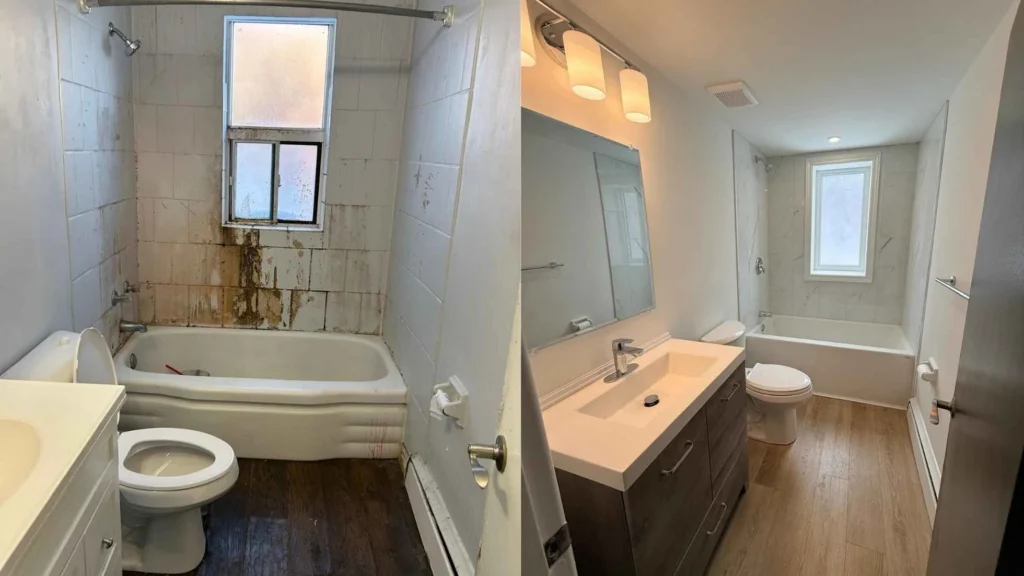
| Bathroom renovation cost in Hamilton, Ontario (2026)
A powder room refresh (fixtures, tile, vanity) typically falls in the $10,000–$18,000 range. A full main bathroom gut renovation runs higher $25,000–$50,000 is common once you account for plumbing, tile, and what the walls hide. A custom ensuite with heated floors and full tile work can reach $55,000–$85,000+. |
Let me be direct with you about something most renovation content won’t say: the number you find online for a bathroom renovation is almost always wrong for your bathroom.
Not wrong because someone lied. Wrong because a bathroom in a 1950s Westdale bungalow is a completely different project than a bathroom in a new-build detached in Ancaster. The tile square footage is similar. The pipes underneath are not.
I’ve been doing this in Hamilton for 12 years. I’ve seen what’s behind the walls of homes on Locke Street, on the East Mountain, in Binbrook. The number that matters isn’t what you read in a national home improvement guide it’s the number that comes out of an honest conversation about your specific bathroom.
But you still need to start somewhere. So let’s talk through what actually drives cost, what bathroom types typically involve, and what questions to ask before you commit to anything.
The 6 Things That Actually Drive Bathroom Renovation Cost
Most homeowners focus on the visible stuff — tile color, vanity style, shower door. Those things matter, but they’re rarely where the cost surprises come from. Here’s what actually moves the number:
1. Whether plumbing moves
Keeping your toilet, shower, and sink in the same spots is the single biggest cost lever you have. The moment you want to move any of them — even a foot — you’re into open floors, rerouted drain lines, and potentially touching your stack. In Hamilton’s older housing stock, that stack might be cast iron. Cast iron work adds time and cost that most estimates don’t account for upfront.
2. The age of your home
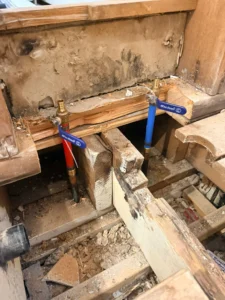
Hamilton has a lot of beautiful older homes. We love working on them. They also have galvanized pipes that are corroding from the inside, subfloors that have been holding moisture for decades, and electrical panels that weren’t designed for bathroom exhaust fans and heated towel bars. None of that is visible until you open the wall.
3. Tile: selection and scope
Tile is both a material cost and a labor cost. Large format tiles (the kind that look stunning in design photos) require more precision to install any imperfection in your subfloor shows. A tile setter in Hamilton doing the work right, on a large-format floor-to-ceiling shower, is not a two-day job. Don’t let anyone quote you like it is.
4. What’s behind the walls, specifically moisture
Bathrooms hold moisture. In homes where ventilation wasn’t great or where a previous renovation wasn’t done properly that moisture has been sitting in the drywall and subfloor for years. When we open the walls, sometimes we find perfectly fine structure. Sometimes we find black mold, rotted subfloor, or drywall that essentially disintegrates when touched. That’s not a scare tactic. It’s a reality we encounter regularly enough that every honest estimate should acknowledge it.
5. Fixtures and materials selection
There’s a wide range between builder-grade and custom. A freestanding soaker tub from a mid-range brand is a different price than the same silhouette from a premium supplier. The same goes for shower hardware, mirrors, vanity tops, and faucets. None of these choices are wrong they’re just choices, and they compound. Six decisions that each add $500 add up to $3,000 before you’ve touched anything structural.
6. Permit requirements
Any bathroom renovation in Hamilton that involves moving plumbing, adding a new bathroom, or making structural changes requires a permit from the City of Hamilton. A contractor who tells you permits aren’t needed for a gut renovation is either mistaken or cutting corners you’ll pay for when you sell. Permit-included work costs more upfront. It’s worth it.
What Different Bathroom Scopes Typically Involve
Rather than giving you hard numbers that may not apply to your home, I’d rather walk you through what each scope of work actually includes so you can evaluate any quote you receive intelligently.
A powder room refresh
This is your smallest scope: a half-bath with a toilet and vanity, no shower or tub. A refresh typically means new vanity, new toilet, new tile (floor only), new fixtures, fresh paint, and updated lighting. No plumbing relocation, no tile on walls. This is the most predictable scope because there’s least risk of discovering hidden problems.
Industry cost guides for Ontario typically place this in the $10,000–$18,000 range, depending on fixture selection.
A full main bathroom renovation
This is the most common scope we see: a full-size bathroom, likely the only or primary bathroom in the house, that needs a complete gut and rebuild. This includes demolition, plumbing assessment (and often some upgrades), new backer board, floor tile, tub surround or shower tile, new vanity, toilet, fixtures, lighting, exhaust, and drywall.
This is also where hidden conditions most often change the final number. If your home is pre-1980 and the bathroom hasn’t been touched, budget for contingency. Ontario renovation data places these projects broadly in the $25,000–$50,000 range, with older homes trending toward the higher end once wall conditions are accounted for.
A custom ensuite
An ensuite renovation or adding an ensuite where one didn’t exist is a different category entirely. You’re often working with a bedroom conversion, which means structural, plumbing rough-in, and electrical all need to be built from scratch in that space. Add heated tile floors, a custom glass shower enclosure, a double vanity, and quality fixtures, and you’re in a range that Ontario industry data places at $55,000–$85,000+.
These projects are not the place to shop on price. A ensuite done wrong moisture, inadequate ventilation, or a drain that doesn’t slope correctly is a problem you won’t discover until you sell, and by then the damage is expensive.
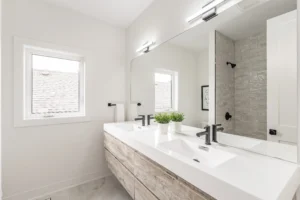
What Hamilton Bathrooms Hide Behind the Walls
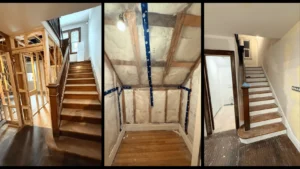
Hamilton’s housing stock is one of its best features and one of its most challenging renovation realities. We have pre-war homes in Kirkendall and Durand, post-war bungalows across the Mountain, and everything in between. These homes were built well, but they’ve been modified by decades of owners, and not always by professionals.
Here’s what we commonly find once demolition begins:
- Cast iron drain lines that are partially collapsed or scaled to near-closure
- Galvanized supply lines with interior corrosion that restricts water pressure
- Subfloor damage from a toilet wax ring that failed silently years ago
- Mold or mildew behind tile that was installed without proper waterproofing membrane
- Electrical work that doesn’t meet current code, no GFCI protection near water sources
- Previous ‘renovations’ done without permits, leaving behind incorrect rough-in heights or non-standard drain sizing
None of this makes your renovation undoable. It means a contingency allowance in your budget is not pessimistic, it’s responsible. Any contractor who tells you there’s no chance of surprises in a Hamilton home that hasn’t been opened in 20+ years either hasn’t done this long enough or isn’t being straight with you.
Our fixed-price contracts address this honestly: we outline what we can see, and we define in writing how we handle what we find. You know how decisions will be made before we start, not after we’ve opened the wall.
The good news: none of what’s above is a reason not to renovate. It’s a reason to go in with the right team and the right contract.
| Thinking about your bathroom? Tell us what you’re working with.
We do a lot of Hamilton bathrooms. We know what to look for, what questions to ask, and what to put in writing before work starts. Tell us about your bathroom, we’ll give you a real picture of what’s involved, not a range pulled from a national guide. |
Refresh vs. Renovation: Knowing Which One You Actually Need
Not every bathroom needs a gut. Knowing the difference saves you money or helps you spend it in the right places.
A refresh makes sense when the layout works, the plumbing is sound, and the bathroom just looks dated. New vanity, new toilet, paint, tile over existing substrate (if the substrate is solid), new lighting. You can meaningfully transform a bathroom in the $12,000–$20,000 range if the bones are good.
A renovation is the right call when:
- The layout doesn’t work for how you use the space
- There’s evidence of moisture: soft floor near the toilet, peeling drywall, musty smell that doesn’t go away
- The tile is cracking or grout is failing, often a sign the substrate beneath is moving
- The plumbing is old enough that partial work would leave you with a mixed system that causes future problems
- You’re planning to sell within 5 years and want the renovation to be visible to a buyer a refresh on a tired bathroom often looks like a refresh
The honest answer is that most Hamilton homeowners who call us +1 343-504-8213 thinking they want a refresh end up deciding on a full renovation once they understand what’s actually there. That’s not a sales conversation, it’s a conversation about doing it once, doing it right.
What a Fixed-Price Bathroom Renovation Contract Should Specify
This is the part most homeowners skip, and it’s the part that determines whether you have a good experience or a nightmare.
A proper fixed-price contract for a bathroom renovation should include:
- A detailed scope of work: what’s included and what’s explicitly excluded
- A material allowance schedule: what you’re getting for fixtures, tile, and hardware, with a clear process for upgrades
- A change order process: in writing, before work starts, explaining how unforeseen conditions (rot, mold, bad plumbing) are handled and how they affect cost
- Permit inclusion: who pulls the permit, who is responsible if it’s rejected, and whether inspections are included
- A payment schedule tied to milestones, not time
- Warranty terms: what’s covered and for how long
We operate on fixed-price contracts. What that means in practice: you know the number before we touch the first tile. The change order process is defined before we start, so if we open a wall and find subfloor damage, there’s no improvised conversation, there’s a written process you already agreed to.
How Gateway Group Handles a Bathroom Renovation in Hamilton
Here’s what working with us on a bathroom renovation actually looks like:
Step 1: The real conversation
Before we talk numbers, we talk about your bathroom. What’s not working. What you’re hoping to walk into when it’s done. What you’re not willing to compromise on, and where you have flexibility. This shapes everything that comes after.
Step 2: Site assessment
We come to your home. We look at the bathroom. We look at what’s accessible — under the vanity, the condition of the grout, the floor near the toilet. We ask about your home’s age and what work has been done before. This is where we start forming a real picture, not a guess.
Step 3: Fixed-price proposal
We produce a detailed proposal that outlines scope, materials, timeline, and price. You know what you’re getting. You know what happens if conditions change. No surprises engineered in.
Step 4: Permits and scheduling
We pull the permits. We manage the City of Hamilton inspection process. You don’t have to follow up with the building department — that’s our job.
Step 5: Daily communication
Every day there’s work happening, you hear from us. Not because we have good news every day — because you deserve to know what’s happening in your home. That’s a standard, not a sales promise.
Step 6: Completion and walkthrough
We walk through the finished bathroom with you. Every detail addressed before we close out. Tarion protection. 4.9 Google rating built on this process, not on advertising.
Frequently Asked Questions Bathroom Renovation Hamilton
Q: How much does a bathroom renovation cost in Hamilton, Ontario?
A: A powder room refresh typically falls between $10,000–$18,000. A full main bathroom gut renovation ranges from $25,000–$50,000+, depending on the condition of the home and scope of plumbing work. Custom ensuite renovations often exceed $55,000. The most accurate number comes from a site assessment of your specific bathroom age of home, current plumbing, and desired scope all affect the final figure significantly.
Q: Do I need a permit for a bathroom renovation in Hamilton?
A: Yes, if your renovation involves moving plumbing, adding a new bathroom, or making structural changes, the City of Hamilton requires a building permit. Work done without a permit can cause problems when you sell your home and may not be covered by insurance. A Tarion-registered builder handles permit applications and inspections as part of the project scope.
Q: How long does a bathroom renovation take in Hamilton?
A: A powder room refresh with no plumbing relocation typically takes 1–2 weeks of active work. A full main bathroom gut renovation usually runs 3–5 weeks, depending on scope and whether hidden conditions are found during demolition. A custom ensuite renovation can take 6–10 weeks. Permit timelines from the City of Hamilton vary and should be factored into the overall project schedule.
Q: What are common hidden problems in Hamilton bathroom renovations?
A: Hamilton’s older housing stock frequently presents subfloor damage from long-standing toilet wax ring leaks, mold behind improperly waterproofed tile, corroded galvanized supply lines, collapsed cast iron drain sections, and electrical wiring that doesn’t meet current code near water sources. A proper site assessment and a clearly defined change order policy in your contract protect you when these are found.
Q: Should I refresh my bathroom or do a full renovation?
A: A refresh makes sense when the layout works, the plumbing is sound, and the bathroom is simply dated. A full renovation is the right call when there are signs of moisture damage, when the layout doesn’t serve how you use the space, or when you want work that will still look and function correctly in 15 years. If you’re unsure, a site assessment is the fastest way to get an honest answer.
Q: What should a bathroom renovation contract include?
A: A proper contract should specify the full scope of work with explicit exclusions, a material allowance schedule, a written change order process for unforeseen conditions, permit inclusion, a milestone-based payment schedule, and warranty terms. Avoid signing any contract that doesn’t define in writing how hidden conditions are handled — this is the most common source of dispute in renovation projects.
Q: How do I find a reliable bathroom renovation contractor in Hamilton?
A: Look for Tarion-registered builders, which indicates government-regulated accountability under Ontario’s new home warranty program. Verify Google reviews and ask for references from projects in similar Hamilton-area homes. Request a fixed-price proposal rather than a time-and-materials quote. Ask specifically how the contractor handles unforeseen conditions found during demolition — the answer tells you a great deal about how the project will be managed.
Tell Us About Your Bathroom
A national cost guide can give you a starting point. A site conversation can give you a real number.
We’ve been renovating bathrooms in Hamilton for 12 years. Westdale, Ancaster, the Mountain, Dundas, we know this housing stock and what it hides. Tarion-registered. Every permit managed end-to-end.
If you’re thinking about a bathroom renovation in Hamilton. We’ll tell you what’s realistic, what to budget for, and what questions to ask any contractor you speak to.
→ Contact us