What Type of Permit Do You Need for a Home Renovation in Hamilton?
7 July 2026
Is $100,000 Enough to Renovate Your Hamilton Home? The Honest Answer for 2026
31 July 2026
Yes for most Hamilton homeowners, a legal duplex conversion pays for itself within roughly 5 to 8 years and adds real resale value. The bigger factor in whether it’s actually worth it isn’t the renovation cost, it’s whether the unit is built legally, to code, on a fixed price, by someone who’s done it before. Most of the projects that end up feeling like a bad decision aren’t bad ideas they’re builds that went over budget, missed permits, or dragged on with no clear end date.
If you’ve been searching “is a duplex conversion worth it Hamilton,” you’ve probably already read a dozen posts about permits and price per square foot. This one covers the part that actually determines the outcome: what a properly built, legal, fixed-price conversion looks like versus one that isn’t and how to tell the difference before you sign anything.
The short answer, with the real math
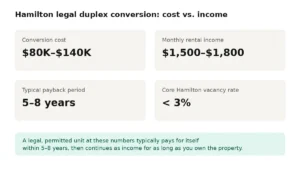
A legal basement-to-duplex conversion in Hamilton typically costs $80,000–$140,000, depending on scope, finishes, and whether the unit needs a separate entrance or full egress windows added. A finished, legal 1-bedroom unit rents for $1,500–$1,800/month in most Hamilton neighborhoods, with vacancy sitting under 3% across the core meaning a compliant unit doesn’t sit empty long once it’s ready.
At those numbers, most homeowners recoup their construction cost in 5 to 8 years, and the unit adds meaningful appraised value on top of that often in the range of tens of thousands of dollars, since a legal, permitted second unit is worth more to an appraiser and a future buyer than an unpermitted one. After payback, it’s income you keep for as long as you own the property.
That’s the financial case, and it’s a strong one. It’s also not the part that makes people hesitate.
What actually determines whether this goes well
Here’s what actually separates a conversion that feels “worth it” from one that doesn’t, based on how these projects typically go wrong in Hamilton: it’s rarely the decision to convert. It’s usually the build itself going over budget, missing a permit, or a project that drags on with no fixed end date.
That’s the part Gateway controls directly, and it’s worth being specific about what “worth it” depends on from a construction standpoint:
A legal, permitted unit holds more value than an unpermitted one. Appraisers and future buyers treat a compliant second unit differently from an informal basement apartment it’s documented, inspected, and legally recognized, which matters at resale even if you never plan to sell.
Layout decisions made before construction starts affect long-term function and value. A separate entrance, proper sound and fire separation between floors, and a genuinely independent unit layout aren’t just nice-to-haves they’re what makes the space work well long-term and hold its value, regardless of how you use it afterward.
Fixed-price, permitted, Tarion-registered construction is what prevents the projects that go sideways. Most of the “was it worth it” regret stories come from projects with unclear scope, no fixed price, or contractors cutting corners to hit a number not from the decision to add a unit in the first place.
🪝 Free Site Assessment Cory walks your property, looks at what it can actually support, and puts together a proposal based on your scope whether that’s a full renovation, a duplex conversion, or a fourplex build. No guessing before you’ve had someone look at the actual house. Book your free site assessment → or call
What “worth it” depends on for you specifically
The ROI math is close to the same for everyone in Hamilton. Whether it’s worth it to you comes down to a shorter list:
- Can your lot and house support a fully self-contained unit (separate entrance, adequate ceiling height, egress windows), or will you be working with a more constrained layout that requires more compromise?
- Is this about rental income, multigenerational living, or resale value because the answer changes what “worth it” even means. A suite built for an aging parent has different priorities than one built purely to add rental income.
- Are you prepared for the timeline and process to be handled properly, permits and inspections included, rather than rushed by a contractor cutting corners to hit a price?
Renovation, duplex conversion, or fourplex build: which one actually fits your property?
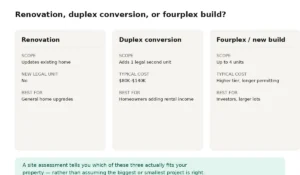
“Duplex conversion” gets used as a catch-all term, but it’s actually one of three distinct project types Gateway builds in Hamilton and knowing which one applies to your property changes the scope, the cost, and the timeline you should be planning around.
A straightforward renovation doesn’t create a second, legally separate unit at all it’s updating the existing home (kitchen, bathroom, structural work) without adding an independently regulated dwelling. If you’re not trying to add a rental unit, this is a different scope and budget entirely from anything above.
A legal duplex conversion takes an existing basement or portion of the house and turns it into a second, code-compliant unit separate entrance, egress windows, fire separation, its own permit and inspection process. This is the $80,000–$140,000 project covered earlier, and it’s the most common conversion Gateway builds in Hamilton right now.
A fourplex conversion or new build is a bigger step converting a property into up to four units under current Hamilton zoning, or constructing new from the ground up with multiple units designed in from the start. This involves more extensive structural work, a longer permitting process, and a different cost tier than a single second-unit conversion, and it’s typically a better fit for investors or larger lots rather than a homeowner adding one income unit.
Which of these actually fits your property depends on your lot, your existing structure, and what you’re trying to get out of it which is exactly what a site assessment resolves. Cory looks at the property first, then scopes the proposal to whichever of these three actually makes sense, rather than assuming the biggest or smallest project is automatically the right fit.
Advantages of converting your existing house vs. other paths
If you’re weighing a conversion against buying a separate income property or a new-build duplex, the advantages of converting what you already own are worth being clear-eyed about:
- No new mortgage or land cost: you’re adding a revenue-generating unit to an asset you already hold, not financing a second property from scratch.
- Faster path to income: than a new build, since you’re not starting from a vacant lot and full site servicing.
- You already know the neighborhood, the house, and its bones: fewer unknowns than acquiring an unfamiliar property.
- Ontario’s zoning reforms work in your favour. Under Bill 23 and current as-of-right zoning, most Hamilton residential lots now permit up to three units without a rezoning application a regulatory window that wasn’t open a few years ago.
The tradeoff is that a conversion is constrained by your existing structure ceiling height, foundation, lot layout in ways a new build isn’t. That’s a feasibility question, not a “worth it” question, and it’s answerable in a single site visit.
Other things Hamilton homeowners ask and how Gateway helps with each
- Will my neighbours complain? Hamilton has specific infill rules built around this exact concern, and it’s an area Gateway follows closely.
- What if I run out of money halfway through? This is exactly what a fixed-price contract exists to prevent no renegotiating once the scope is locked in.
- Is my house even eligible? Most Hamilton lots qualify under current zoning, but ceiling height and lot specifics vary this is what a site assessment tells you directly.
- What’s it actually like living through the construction? Dust, noise, and disruption are real parts of any renovation a clear schedule and site management from the builder are what keep it predictable.
Why this is worth taking seriously in Hamilton right now
Hamilton’s Missing Middle and Infill Housing Subcommittee which Gateway Group’s founder, Charles Wah, sits on exists specifically because the city is actively working through how duplexes, triplexes, and fourplexes fit into established neighborhoods. That means the zoning environment, the permitting process, and the rules around infill construction are shifting in real time, and having someone at the table who understands both sides the policy and the actual construction is a genuine advantage when you’re navigating this as a homeowner. It’s also why getting accurate, current guidance matters more than following advice written for a different city or a different set of bylaws.
How Gateway handles the construction and compliance side
Most contractors stop at the drywall. Gateway’s process starts with Cory doing a site assessment and putting together a proposal based on your actual scope renovation, duplex conversion, or fourplex build so you’re working from a real plan for your property, not a generic estimate:
- Permits and inspections are handled for you, so you’re not chasing paperwork or guessing whether the unit will pass.
- Tarion registration protects the build itself, so the one thing you’re not worrying about is whether the construction was done right.
- Fixed-price contracts remove the financial uncertainty that makes projects go over budget or stall halfway the risk that actually stops most Hamilton homeowners from starting.
- A well-planned layout separate entrance, proper sound and fire separation is a construction detail decided at the design stage, not something added after the unit is built.
This is what Gateway controls and puts in writing: a legal, permitted, fixed-price build. That’s the part that actually determines whether the project is worth it.
🪝 Not sure what your property can support? A free site assessment with Cory tells you what’s actually possible on your lot, and gets you a proposal scoped to what you want to build — before you spend a dollar on construction. Book your free site assessment with Gateway Group → or call
If you’re trying to decide whether a duplex conversion is worth it for your specific property, the fastest way to get a real answer isn’t another blog post it’s a site assessment with someone who’ll tell you honestly what your house supports. Book your free site assessment → or call
Frequently Asked Questions
Does a legal, permitted unit actually add more value than an unpermitted one? Yes. Appraisers and future buyers treat a compliant, inspected second unit differently from an informal conversion it’s documented and legally recognized, which matters at resale even if you never plan to sell.
How do I know if my Hamilton property is eligible for a duplex conversion? Most Hamilton residential lots now qualify for a second unit under current as-of-right zoning, but ceiling height, egress requirements, and lot specifics vary by property. A site assessment is the fastest way to get a real answer for your house.
What’s included in a fixed-price contract for a duplex conversion? A fixed-price contract locks in the total cost before construction starts, covering the agreed scope of work so there’s no renegotiating mid-project if something the contractor should have accounted for comes up later.
What does Gateway’s site assessment process actually involve? Cory visits the property, evaluates what the lot and structure can support, and puts together a proposal scoped to what you want to build whether that’s a renovation, a duplex conversion, or a fourplex build.
How long does it take to recoup the cost of a duplex conversion in Hamilton? Most homeowners recoup construction costs within 5 to 8 years based on typical Hamilton rents and conversion costs, though individual results vary by scope, finishes, and rental rates.