Builder vs. Contractor in Ontario: What Hamilton Homeowners Need to Know Before They Sign Anything
27 May 2026
Kitchen Renovation Cost in Hamilton, Ontario: Real Numbers for 2026
19 June 2026
| A legal duplex conversion in Hamilton turns a single home into two self-contained units, each meeting the Ontario Building Code and the City’s zoning by-law. You need a building permit, a 30-minute fire separation between the units, code-compliant egress and ceiling height, interconnected smoke and carbon-monoxide alarms, and separate municipal addressing. Most conversions run roughly four to eight months from permit to occupancy. |
You walk through your house and you can already see it. The basement with its own side door. The bedroom level that could stand on its own. The question isn’t whether the space is there. It’s whether the city will call it legal once you’re done.
That word, legal, is where most Hamilton duplex projects either work or quietly fall apart. A unit isn’t legal because it has a kitchen and a separate door. It’s legal because it satisfies two things at once: the City’s zoning by-law says you’re allowed that many units on your lot, and the build meets the Ontario Building Code. Miss either one and you end up with a finished unit you can’t insure, refinance, or rent the way you planned.
This guide walks through what “legal” actually requires for a duplex in Hamilton, how many units your lot may already permit, and the question we get asked more than almost any other: can your garage become the second unit? It’s written for the homeowner sizing up their own house and the investor sizing up a purchase. By the end you should be able to look at a property and know roughly what it can become.
What makes a duplex “legal” in Hamilton?
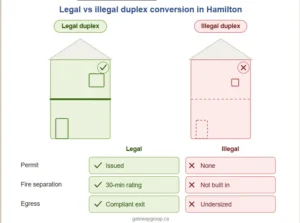
A duplex is legal in Hamilton when the property is zoned to allow two dwelling units and the construction meets the Ontario Building Code. Both have to be true. Zoning decides whether you’re allowed to have a second unit at all; the Building Code decides whether the way you built it is safe enough to occupy.
These are two separate approvals from two separate parts of the City. Zoning lives with the Planning side. The Building Code is enforced through your building permit and the inspections that follow. Plenty of homeowners get the construction right and stall on zoning, or get zoning confirmation and then fail an inspection on something like fire separation. Treating them as one step is the most common reason a project drags.
Gateway handles both sides as one scope. We confirm what your lot legally permits before any design work starts, then carry the build through permit and final inspection so the unit is legal on paper and in the wall assemblies. If you want the broader picture across basement suites, duplexes, triplexes and fourplexes, our companion guide on what gets approved in Hamilton covers the full range.
What are the requirements for a legal duplex in Ontario?
A legal duplex in Ontario needs zoning permission for a second unit, a building permit, a 30-minute fire separation between the two units, a compliant means of egress for each unit, minimum ceiling height, interconnected smoke and carbon-monoxide alarms, and an electrical permit. The details below are where projects pass or fail.
Here’s the working checklist we use on Hamilton conversions. Source notes are at the end of the article.
1. Zoning permission for two units
Your lot has to permit a second dwelling unit. In Hamilton this is now true for most residential properties, but lot size, frontage and overlays (like heritage or escarpment areas) can change what’s allowed. If your design doesn’t quite fit the by-law, you can apply for a minor variance, which adds time but is often granted for reasonable second-unit proposals.
2. A building permit
Adding a second unit is a change that requires a building permit from the City of Hamilton. The permit is what triggers the inspections that make the unit legal. Skipping it is what creates “illegal” units that look finished but can’t be rented or insured properly.
3. A 30-minute fire separation between units
The Ontario Building Code requires a 30-minute fire-resistance rating between the two units and between each unit and any shared space. In practice that usually means fire-rated drywall on the assemblies that divide the units. If the whole house has interconnected smoke alarms, that separation can sometimes be reduced to 15 minutes. The 2024 Code update added some flexibility for older homes, including smoke-tight barrier options for existing buildings, which can make tight conversions more workable.
4. A safe way out (egress)
Each unit needs a compliant way to exit in an emergency. A unit with its own direct exit or walk-out to the outside is the simplest case. Where a unit has no dedicated exterior exit, bedrooms generally need an egress window with a minimum opening of about 0.35 square meters and no dimension smaller than roughly 380 mm, openable from inside without tools. This is the requirement homeowners most often underestimate, because a basement window that looks big enough frequently isn’t.
5. Ceiling height
A second unit in a basement is permitted with a ceiling height of 1.95 m (about 6 feet 5 inches) over the required floor area, including the path to the exit. Bulkheads, ducts and old beams are the usual culprits when a basement comes up short. If you’re below the minimum, you may be looking at underpinning or bench-lowering the floor before the City will issue a permit, which changes the budget meaningfully.
6. Smoke and carbon-monoxide alarms
Interconnected smoke alarms are required, with a visual signal (a strobe) in bedrooms and shared egress areas. Carbon-monoxide detectors are required where there’s a fuel-burning appliance or an attached garage. Interconnection is what lets the alarms cover the whole building and, as noted above, can ease the fire-separation requirement.
7. Electrical sign-off
A second unit means electrical work that has to be inspected and approved by the Electrical Safety Authority (ESA) under its own permit, separate from the building permit. Many conversions also separate or sub-meter the units; separate metering isn’t always legally mandatory, but it makes renting cleaner and is worth planning for early.
8. Heating, ventilation and sound
Each unit needs adequate heat and ventilation; a second unit generally can’t simply borrow heat from the main house. Sound separation isn’t strictly a life-safety item, but the same fire-rated assemblies that satisfy the Code also cut noise between units, which matters a lot when you’re the one living upstairs from your tenant.
| Almost every approval problem on a Hamilton duplex traces back to three things: ceiling height that’s a few centimeters short, an exit or window that doesn’t meet egress, and fire separation that wasn’t built into the right walls. Get those three designed correctly before anyone picks flooring, and the rest tends to follow. |
How many units can you actually have? Hamilton’s zoning, simplified
Most residential lots in Ontario now allow up to three dwelling units as of right, meaning without a rezoning or variance, under the province’s Bill 23 (the More Homes Built Faster Act). Hamilton goes further: since February 2024 the City’s zoning by-law has permitted up to four units on many Low Density Residential lots, and additional dwelling units — internal and detached — are allowed on most residential properties.
Why this matters for a duplex conversation: a duplex is two units. If your lot supports three or four, a duplex might be the starting point rather than the ceiling. The same property assessment that confirms a legal duplex often reveals room for a third unit (a basement suite or a detached unit out back), which changes the income math without changing the lot you already own. Hamilton updated its residential zoning rules again in late 2025, so the specific numbers for your zone are worth confirming rather than assuming.
If a duplex turns out to be the floor, our guide to triplex and fourplex conversions picks up where this one ends, and Hamilton’s $40,000-per-unit ADU grant can offset eligible costs on qualifying additional units.
Can I convert an attached garage into another legal unit in Hamilton’s residential zone?
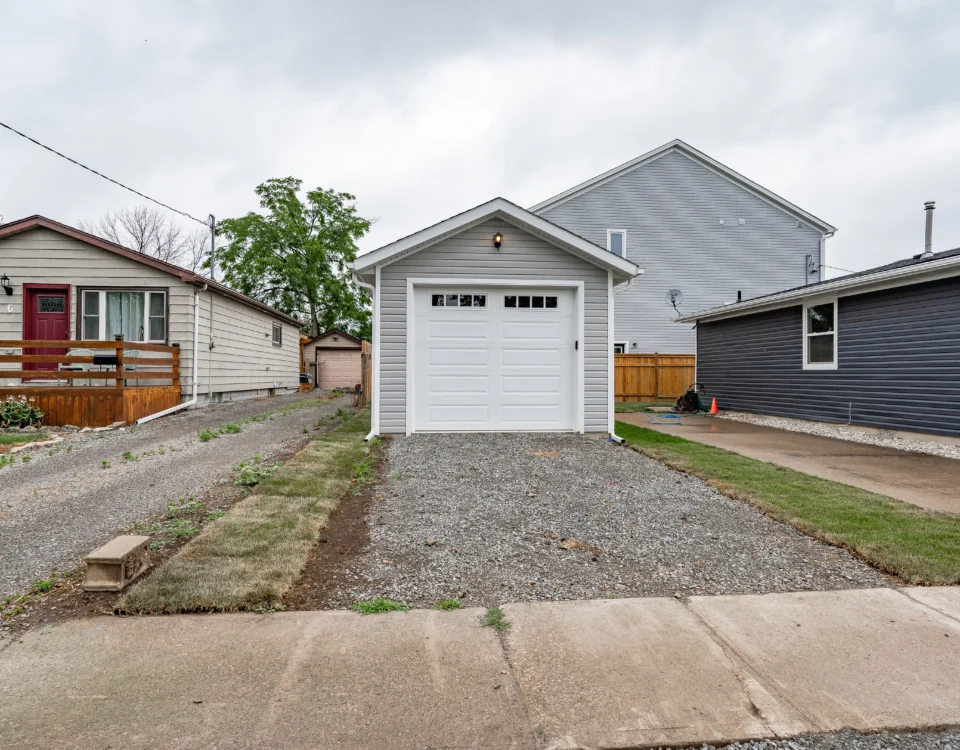
Yes, in many cases you can convert a garage into a legal dwelling unit in Hamilton, but an attached garage conversion is treated as an addition to your home, which means it always requires a building permit, and the new space has to meet the same Building Code standards as any other living area. A detached garage is treated differently again: it can often become a detached additional dwelling unit (ADU-D).
This is the question Hamilton homeowners ask us constantly, and it’s where a lot of good potential gets overlooked. Here’s how it actually works.
Attached garage vs detached garage, they follow different rules
An attached garage is part of your principal dwelling, so converting it into living space counts as an addition and always needs a building permit, regardless of size. Folded into a duplex conversion, that garage footprint can become part of the second unit or the second unit itself. A detached garage in the rear yard is a different path: the City explicitly allows converting an existing detached garage or shed into a self-contained detached additional dwelling unit, subject to lot size, setbacks and Code.
What a garage has to gain to become a legal unit
A garage is built to shelter a car, not a person, so the conversion has to add everything a habitable space needs:
- Insulation that meets the Building Code for walls, ceiling and the slab, plus a vapour barrier on the concrete.
- Its own heat. The unit needs a mechanical heating source; it can’t lean on the main house’s system.
- Egress. Any bedroom needs a compliant emergency exit window or door.
- Fire separation. An attached garage conversion has to meet the Code’s separation requirements between the former garage and the rest of the dwelling.
- Upgraded electrical to residential standard, inspected by ESA, and a carbon-monoxide detector.
- A municipal address. New units in Hamilton now have to be assigned and post a municipal address or unit number.
The hidden advantage on a lot of Hamilton homes
A surprising number of older Hamilton homes, especially on the Mountain, already have a side door, a separate walk-out, or a garage positioned in a way that makes a second entrance straightforward. That separate access is often the single most valuable thing a property can have for a conversion, because it solves egress and unit separation at the same time. When we read a property, the garage and the side entrance are two of the first things we look at.
One thing worth flagging: Hamilton has eased parking requirements for additional units, which removes a constraint many homeowners assume still blocks them. Confirm the rule for your specific zone, but the old fear that “I’d lose my parking, so I can’t do it” is frequently no longer true.
The permit process, in brief
At a high level, a legal duplex conversion in Hamilton moves through five stages: a zoning and feasibility read of the property, design and the building-permit application, the build itself, inspections at each required stage, and final sign-off plus municipal addressing. Most projects run about four to eight months depending on the existing structure and whether any variance is needed.
We’ve kept this short on purpose. Our dedicated guide to the duplex conversion process and real costs walks through each stage, what causes delays, and the budget ranges, so this article can stay focused on what makes the unit legal. The short version of how Gateway works: we own the permits and approvals end to end, work to a fixed-price contract so the number doesn’t move on you, and send daily WhatsApp updates so you always know where the project stands.
What homeowners consistently underestimate
The drawings are rarely where conversions go wrong. It’s the conditions in an older Hamilton house that surprise people:
- Ceiling height. A few centimeters short turns a tidy basement suite into an underpinning project.
- Egress. The existing window almost never meets the opening requirement, and cutting a new egress window in a foundation wall is real work.
- Electrical. A second unit usually needs panel and circuit upgrades plus a separate ESA permit, not just a few new outlets.
- HVAC. Heating and ventilating two units properly is more than splitting the existing system.
- Old, unpermitted work. Renovations a previous owner did without permits can surface during inspection and have to be corrected before the new unit passes.
None of these make a conversion a bad idea. They’re the reason the property assessment comes first. Knowing about the short ceiling or the undersized window before you commit is the difference between a budget that holds and one that doesn’t.
A real Hamilton duplex conversion
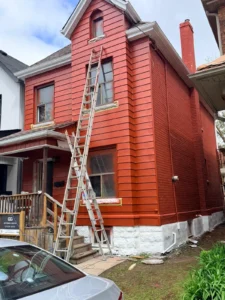
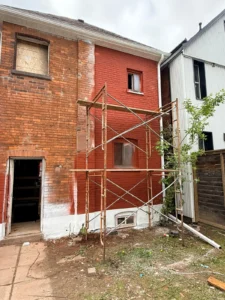
This is 29 Myrtle, one of our active duplex conversions for McGivney Community Homes. From the street it still reads as a single home, and by the time this stage is finished it will be two legal units under one roof. The work in the photo isn’t the glamorous part of a conversion. It’s the exterior envelope and the foundation being brought up to standard, plus the kind of at-grade basement window that has to meet egress before a lower unit can be called legal. Kitchens and finishes come later. This stage is the one that quietly decides whether the second unit is legal at all.
Frequently asked questions
What makes a duplex legal in Hamilton?
A duplex is legal in Hamilton when the lot is zoned for two dwelling units and the construction meets the Ontario Building Code, confirmed through a building permit and final inspection. Zoning permission and Code compliance both have to be in place; one without the other leaves the unit illegal.
What are the requirements for a legal duplex in Ontario?
A legal duplex in Ontario needs zoning permission for a second unit, a building permit, a 30-minute fire separation between units, compliant egress for each unit, minimum ceiling height (1.95 m in a basement unit), interconnected smoke and carbon-monoxide alarms, and an ESA-approved electrical permit.
Can I convert my attached garage into a legal unit in Hamilton?
Often yes. An attached garage conversion is treated as an addition, so it always needs a building permit and must meet the Building Code for habitable space — insulation, its own heat, egress, fire separation, upgraded electrical and a CO detector. A detached garage can usually become a detached additional dwelling unit instead.
How many units can I have on my Hamilton lot?
Most Ontario lots allow up to three units as of right under Bill 23. Hamilton permits up to four units on many Low Density Residential lots since 2024. The exact number depends on your specific zone, lot size and any overlays, so confirm before designing.
How long does a legal duplex conversion take in Hamilton?
Most legal duplex conversions in Hamilton take about four to eight months from permit to occupancy. Timing depends on the existing structure, whether a minor variance is needed, and the inspection schedule.
Do I need a permit to convert my house into a duplex?
Yes. Adding a second dwelling unit requires a building permit from the City of Hamilton, plus a separate electrical permit through the ESA. The permit is what triggers the inspections that make the unit legal, insurable and rentable.
What is the difference between a legal and an illegal duplex?
A legal duplex was permitted and inspected, so it meets zoning and the Building Code. An illegal duplex skipped the permit or fails Code on items like egress, ceiling height or fire separation. Illegal units are hard to insure, refinance or rent without risk.
Will a duplex conversion affect my property taxes?
It can. Adding a legal second unit may change your property’s assessed value and therefore its taxes. It’s worth confirming the likely impact upfront so it’s part of your numbers, not a surprise later.
| What can your property legally become?
Every conversion starts with a property read: what your lot, your existing home and Hamilton’s zoning will actually allow. We’ve been building in Hamilton since 2012. Tarion-registered. 4.9 stars. WEHBA Award of Distinction 2025. DM us your address we’ll give you the honest answer in 24 hours. |