How to Find a Legitimate Home Builder in Hamilton(And Why It Matters More Than Price)
22 April 2026
Why Renovations Spiral Out of Control in Hamilton And How to Stop It Before You Start
18 May 2026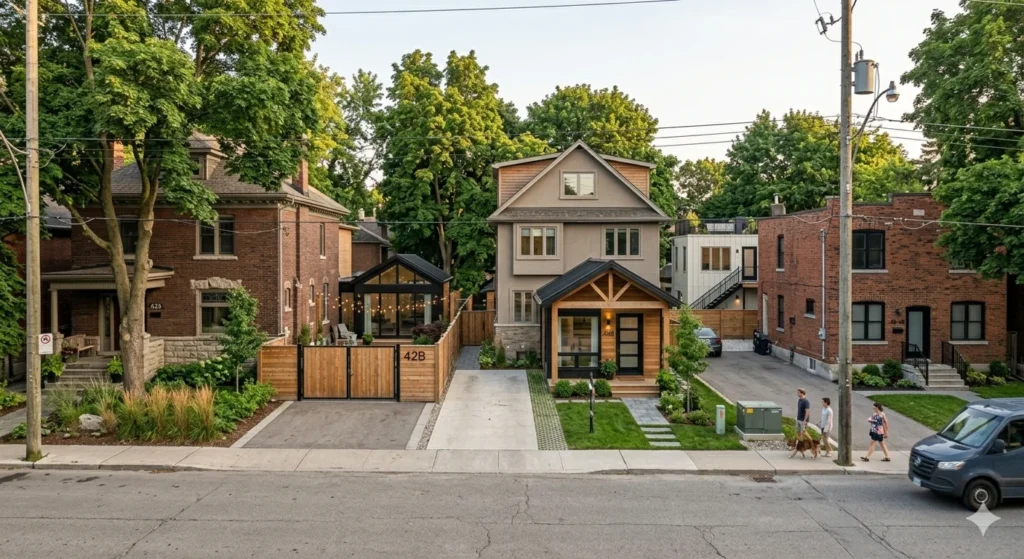
A lot of Hamilton homeowners start by Googling. They search ‘garden suite Hamilton’ or ‘can I build a backyard suite on my property’ and find Ontario-wide guides full of general information that doesn’t actually tell them anything about their specific lot.
This article is different. It’s built around one question: can your property actually support a garden suite and how do you find out without spending a dollar?
We’ll walk through the six checks that determine whether a detached ADU is feasible on a Hamilton residential property. You can do most of them yourself, from your kitchen table, in roughly ten minutes. The last one requires a conversation with someone who knows Hamilton’s zoning but by the time you get there, you’ll have enough information to make that conversation useful.
One more thing before we start: Hamilton currently offers up to $40,000 per unit through its ADU and Multi-Plex Housing Incentive Program, updated in February 2026. If your property qualifies, that money is available. We’ll cover it.
| 📍 Who this is for:
You own a single-detached, semi-detached, or street townhouse dwelling in Hamilton, Ontario. You have a rear yard. You’re wondering whether a garden suite, a self-contained detached unit is possible on your lot, and whether it’s worth pursuing. |
What Is a Garden Suite, and Why Are Hamilton Homeowners Building Them?
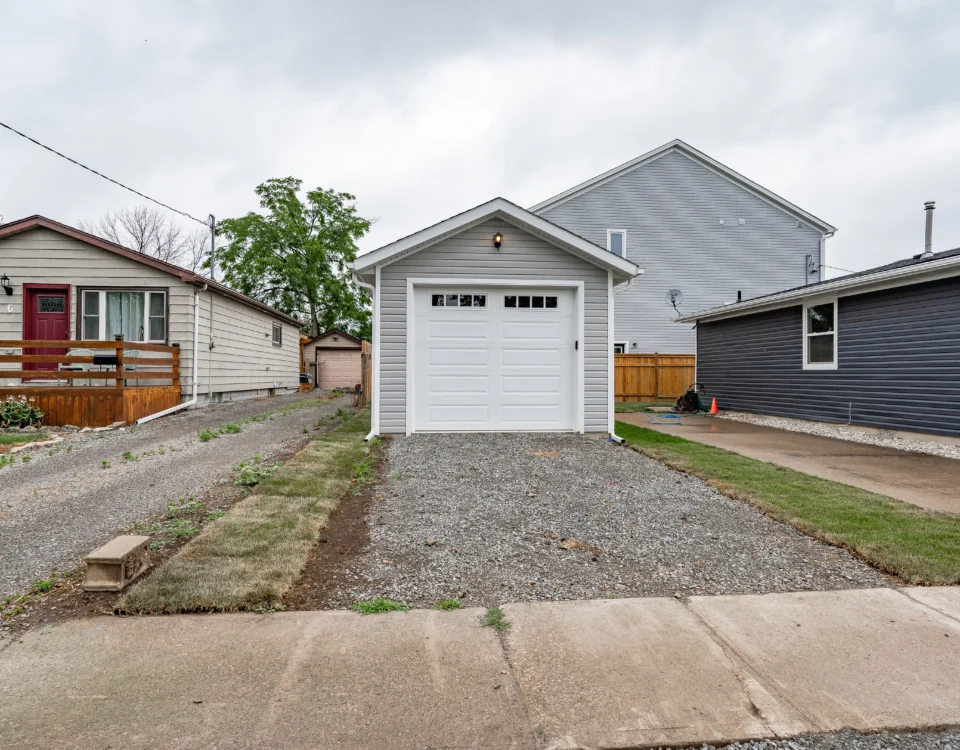
A garden suite is a self-contained residential unit built in the rear yard of an existing residential property detached from the main house, with its own kitchen, bathroom, and entrance. In Hamilton, the planning documents call it a detached Additional Dwelling Unit (ADU). Some people call it a backyard suite, a coach house, or a laneway home. They’re all variations of the same idea.
Hamilton’s zoning bylaws were amended in 2021 and updated in 2022 (By-laws 22-132 through 22-138) to permit one detached ADU on lots containing single-detached, semi-detached, or street townhouse dwellings across most of the urban residential zones in the city. That means the zoning is likely already on your side. The question is whether your specific property can physically accommodate one.
Why are Hamilton homeowners building them?
- Rental income. A one-bedroom garden suite in Hamilton currently rents in the range of $1,600 to $1,950 per month depending on location, size, and finishes.
- Multigenerational living. An aging parent or adult child can live independently on the same property without the compromise of a shared basement.
- Property value. In the 2026 Hamilton market, properties with a permitted detached ADU are selling at a meaningful premium over comparable standard single-family homes.
- The $40,000 grant. Hamilton’s current incentive program covers 70% of eligible construction costs, up to $40,000 per unit. That changes the math on a lot of projects that previously seemed financially marginal.
The 10-Minute Property Check: Six Things to Look At Before You Call Anyone
Before spending money on drawings, assessments, or consultations, you can do a preliminary check yourself. These six factors determine whether a garden suite is likely feasible on your property. None of them require a professional but they’ll tell you whether it’s worth getting one involved.
Check 1: Do You Own the Right Property Type?
Hamilton’s detached ADU bylaw applies to lots containing single-detached dwellings, semi-detached dwellings, and street townhouse dwellings. If your property falls into one of these categories, you’re starting from the right place.
If you own a property inside Hamilton’s urban boundary, you’re almost certainly in an eligible zone. The exception is properties within the Niagara Escarpment Plan area parts of Flamborough, Dundas, and some rural fringe areas, where additional approvals from the Niagara Escarpment Commission are required before a municipal building permit can be issued.
| Quick check:
Look at your property tax bill or the City of Hamilton’s online mapping tool. If your property is within the urban boundary and your primary structure is a single-detached, semi-detached, or townhouse, you’re likely in scope. |
Check 2: Measure Your Rear Yard Depth
This is the single most important physical check. Garden suites need room.
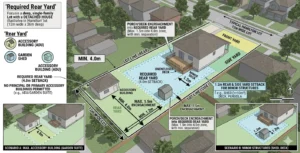
Hamilton’s bylaw requires a 4.0-metre setback between the garden suite and the primary dwelling (reduced from 7.5 meters in a 2024 amendment, a significant change that opened up more properties than before). Beyond that, the garden suite itself needs 1.2-metre setbacks from the rear and side property lines.
What does that mean in practice? If your rear yard depth measured from the back wall of your main house to your rear lot line is less than roughly 30 to 35 feet (9 to 11 meters), fitting a functional garden suite becomes difficult. Not impossible, but the design options shrink.
A deeper lot of 40+ feet from the house gives you real flexibility. Many pre-war Hamilton homes bungalows and two-story in Crown Point, Gibson, Barton Village, the West End, and parts of the Mountain sit on lots with 120 to 150 feet of total depth. On properties like these, the math usually works.
| How to measure:
Step it off or use Google Maps satellite view. From the rear wall of your house to your back fence, count your paces (roughly 1 meter per pace). If you’re at 10+ meters, you likely have room to work with. Under 8 meters, a garden suite is probably a stretch. |
Check 3: Check Your Lot Coverage
Hamilton’s ADU bylaw limits the gross floor area of a garden suite to a maximum of 75 square meters (about 807 square feet). It also cannot exceed the gross floor area of the principal dwelling so if your house is 600 square feet, your garden suite can’t be 700.
Additionally, the total lot coverage across all structures on the property (main house, garage, garden suite, sheds) generally cannot exceed 25%. On a standard urban lot, this usually isn’t the binding constraint but on a narrower infill lot, it can matter.
You don’t need a surveyor for this check. Look up your property’s lot size on the City’s mapping tools, calculate 25%, and compare it to your existing footprint. If you’re already close to 20–22% coverage with your house and garage, a garden suite may push you over and require a minor variance.
Check 4: Assess Rear Yard Access
The building crew needs to get into your rear yard to build. So do your future tenants. And the City will look at access when reviewing your permit application.
Properties with a dedicated lane, a side gate, or an oversized driveway that extends to the rear yard have the easiest path. Corner lots are often in good shape because there’s typically street access along the side lot.
Properties where the only access to the rear yard is through the main house, or through a side yard that’s less than 1 meter wide, create real complications. Not always dealbreakers sometimes a construction access variance or a shared arrangement with a neighbor is workable but worth identifying early.
Check 5: Water Service, The One Nobody Talks About
This is where a lot of Hamilton homeowners get caught off guard.
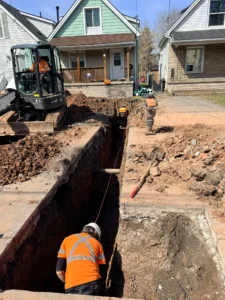
Before the City of Hamilton will issue a building permit for a detached ADU, they require a water service assessment. The assessment determines whether your existing water service line the pipe connecting your property to the municipal water main is large enough to support the additional demand of a second dwelling unit.
If it isn’t, you’ll need to upgrade it before you can proceed. Water service upgrades in Hamilton typically cost between $4000 to $5000 depending on the length of the run from the main to your property and the materials involved. That cost is real, and it needs to be in your budget before you fall in love with a design.
The water service assessment isn’t difficult to obtain. You can request one through the City, and an experienced local contractor will know exactly what to ask for and how to read the result. But you want to know before your permit application is in not after.
| Gateway Group note:
We include water service review in every garden suite feasibility assessment we do. It’s one of the first things we look at because it affects cost and timeline more than almost any other factor. |
Check 6: Zoning Confirmation, The Final Step
Most of Hamilton’s low-density residential zones permit detached ADUs as of right, meaning no rezoning application or Committee of Adjustment hearing is required. This is the result of the 2021–2022 zoning amendments and represents a significant simplification over older rules.
However, ‘as of right’ doesn’t mean no review. Your application still goes through the standard building permit process. And in some areas older secondary plan areas, properties near the Niagara Escarpment Plan boundary, and certain legacy zoning designations the rules differ from the standard bylaw.
The fastest way to confirm your zoning is through Hamilton’s online mapping tools or a direct inquiry to the Zoning section at the City. An experienced local builder can usually tell you within minutes based on your address.
What the $40,000 Grant Actually Covers and How to Stack It
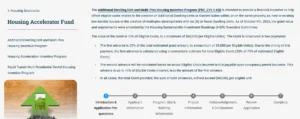
The City of Hamilton’s Additional Dwelling Unit and Multi-Plex Housing Incentive Program was updated in February 2026. The current version — the one that’s actually in effect right now — is worth understanding before you make any financial decision about a garden suite.
Here’s what the program looks like:
| Program Feature | Details |
| Grant value | 70% of eligible costs, maximum $40,000 per unit |
| First payment | $8,000 (20% of the max grant amount) — released after building permit is issued |
| Second payment | Up to $32,000 — released after final occupancy permit and program conditions are met |
| Deadline | Final occupancy permit must be issued by August 4, 2027 |
| Eligibility | Property must be in Hamilton, no outstanding property standards orders, taxes current, building permit issued |
| Owner-occupied required? | No — investors and owner-occupants are both eligible |
Three things about this grant that most sources get wrong or miss entirely:
- The $40,000 figure is the updated amount, amended in October 2025. Older articles citing $25,000 are referencing a prior version of the program. The current program, confirmed in the February 2026 City document, is $40,000 maximum per unit.
- The grant applies to garden suites, basement suites, and small multiplexes not just one type. So if you’re building a garden suite AND a basement suite on the same property, you may be eligible for the grant on both units, up to the per-unit cap.
- The application is submitted at the same time as your building permit application, not after. Getting your permit-ready drawings and grant application aligned from the start is essential. A builder who has done this before knows exactly what documentation the City needs.
What a Garden Suite Costs to Build in Hamilton, Honest Numbers for 2026
The range is wide, and the internet isn’t always honest about it. Here’s what to expect:
- Small garden suite (400–500 sq ft, 1 bedroom): $200,000 to $275,000 including foundation, mechanical, and permit costs
- Mid-size garden suite (500–650 sq ft, 1–2 bedrooms): $250,000 to $325,000
- Larger garden suite (650–807 sq ft, 2 bedrooms at maximum allowed size): $300,000 to $400,000+
These are construction costs. They don’t include your water service upgrade if one is needed ($10,000 to $40,000), or the design and drawing costs required before permit submission.
The grant covers 70% of eligible construction costs, up to $40,000. On a $250,000 build, that’s a meaningful reduction. On a $350,000 build, it’s still $40,000 off the top worth having.
One more number worth knowing: in the current Hamilton market, a permitted one-bedroom garden suite rents for $1,600 to $1,950 per month. At $1,750/month on a $250,000 build with $40,000 in grant funding, the net cost is $210,000 and the annual rental income is $21,000. That’s a payback period of roughly 10 years, before accounting for the property value increase.
When a Garden Suite Doesn’t Make Sense and What Might Work Better
Not every property is a garden suite candidate. If your self-assessment raised concerns, here’s how to think about what you’re working with:
Shallow rear yard (under 8 meters from house to fence)
A garden suite probably won’t fit within the setback requirements. But a basement suite conversion might it doesn’t depend on rear yard depth at all. A legal basement suite in Hamilton rents for $1,500 to $1,850 per month and costs $80,000 to $150,000 to build. It’s not the same as a detached suite, but it’s often the better financial choice on a tighter lot.
Water service cost is prohibitive
If the water service upgrade quote comes in high, the project economics may change. One option: build the basement suite first (no water service assessment required) and return to the garden suite later if the service can be upgraded as part of a larger street infrastructure project.
Lot coverage is already at or near 25%
Minor variances are available for situations where the bylaw can’t quite be met. The process adds 4 to 12 weeks and a $750 application fee. It’s not automatic the Committee of Adjustment evaluates each case but for genuinely minor technical non-compliance, approvals are common.
Property is near the Niagara Escarpment Plan boundary
Properties in the Escarpment Plan area require a Development Permit from the Niagara Escarpment Commission before a City building permit can be issued. This process is more involved. If your property is in Flamborough, parts of Dundas, or the rural fringe, confirm your status before planning anything.
How the Garden Suite Process Actually Works: From Feasibility to Occupancy
If your self-assessment indicates a garden suite is feasible, here’s the standard path from that point to a tenant in the unit:
- — A professional reviews your lot dimensions, zoning, water service status, and access constraints. This is the step that confirms or adjusts your preliminary check. A good assessment takes 30 to 60 minutes and costs nothing with the right builder.
- — Architectural drawings are prepared to Ontario Building Code and Hamilton zoning standards. These are submitted with your permit application and must be stamped by a qualified designer or architect.
- — The City reviews your water service. If an upgrade is needed, it’s scheduled and completed before permit issuance. Water service assessment and upgrade (if required)
- — Building permit and grant applications are submitted simultaneously. The first $8,000 grant advance is released after permit issuance. Permit application and grant application
- — A detached garden suite typically takes 4 to 8 months from permit to completion, depending on foundation type, size, and scheduling. Construction
- — The City conducts final inspections and issues the occupancy permit. The remaining grant balance (up to $32,000) is released at this stage. Final inspection and occupancy
- — With a permitted, code-compliant suite, you can advertise, execute a lease, and collect rent. Rental
Total timeline from feasibility to occupancy: typically 10 to 18 months. Projects with existing municipal infrastructure in good shape and no variance requirements run faster. Properties needing water service upgrades or minor variances run longer.
Why Hamilton Homeowners Work With Gateway Group on Garden Suites
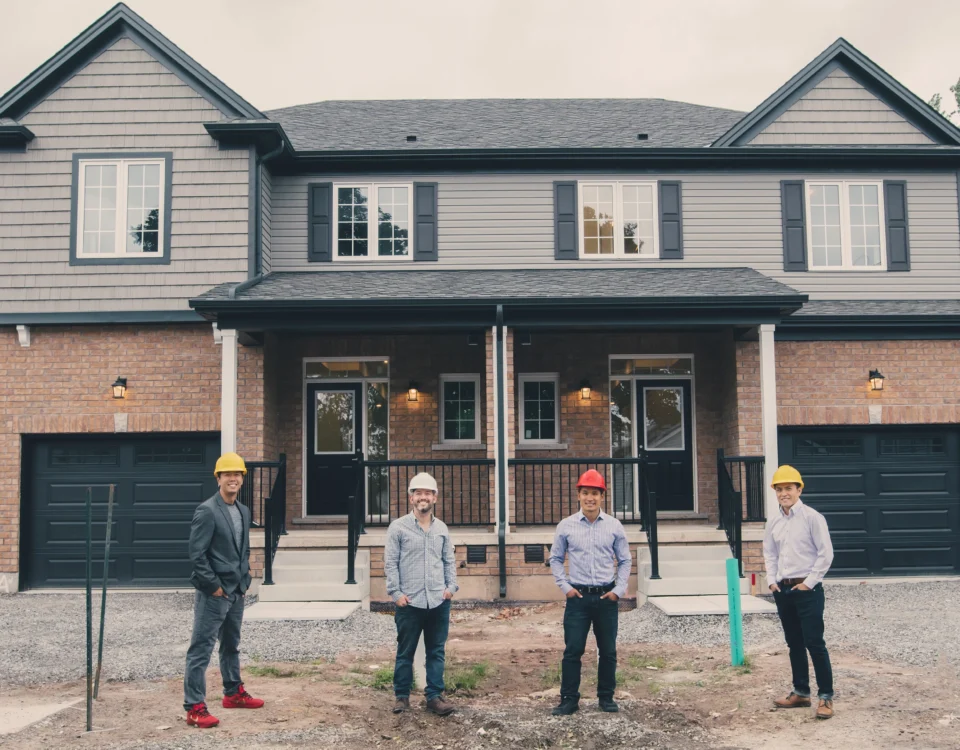
Gateway Group is a Tarion-registered design-build construction company based in Hamilton, Ontario. We’ve worked in this city for over 12 years, across the lower city, the Mountain, East Hamilton, Stoney Creek, Dundas, and Ancaster.
Our founder, Charles Wah, sits on Hamilton’s Missing Middle and Infill Development Subcommittee. That’s not a marketing line it means he’s in the room where Hamilton’s ADU policy gets discussed and shaped, and that knowledge directly informs how we approach every garden suite and ADU project we take on.
We hold a 4.9-star Google rating and the WEHBA Award of Distinction 2025. We’re not the cheapest option in Hamilton. We’re the most reliable path from feasibility to a finished, permitted, income-generating suite for homeowners who want certainty, not surprises.
Our approach to garden suite projects starts with a frank feasibility review. We look at your lot, your water service, your zoning status, and your financial numbers. If a garden suite isn’t the right call for your property, we’ll tell you. If it is, we’ll show you what the real costs look like before anyone signs anything.
| Gateway Group handles everything: feasibility → design → permits → construction → occupancy. You don’t manage multiple contractors. You get one point of contact, WhatsApp updates, and a builder who’s done this in Hamilton. |
Frequently Asked Questions: Garden Suites in Hamilton
Q: Can I build a garden suite on my Hamilton property?
A: If you own a single-detached, semi-detached, or street townhouse dwelling within Hamilton’s urban boundary, you can likely build one detached ADU in your rear yard under Hamilton’s current zoning bylaws. The key variables are rear yard depth, lot coverage, water service capacity, and access. A 10-minute self-check using the criteria in this article will tell you whether your property is worth a professional assessment.
Q: What are Hamilton’s rules for garden suite size?
A: The gross floor area of a garden suite in Hamilton cannot exceed 75 square meters (approximately 807 square feet) and cannot be larger than the principal dwelling. Maximum building height is 6 meters. The suite can have no more than two bedrooms. A 4.0-metre setback from the primary dwelling is required (reduced from 7.5 meters in a 2024 bylaw update), along with 1.2-metre setbacks from the rear and side lot lines.
Q: How much does a garden suite cost to build in Hamilton in 2026?
A: Expect $200,000 to $400,000 depending on size, finishes, foundation type, and site conditions. A one-bedroom unit typically falls in the $220,000 to $290,000 range before the grant. The City of Hamilton’s ADU incentive program covers 70% of eligible costs up to $40,000 per unit. Water service upgrades, if required, add $4000 to $5000.
Q: Do garden suites require permits in Hamilton?
A: Yes. A building permit is required for every garden suite project. The City of Hamilton has a dedicated ADU team. You also need a water service assessment before a permit is issued. Skipping permits creates liability that follows the property not just you and disqualifies you from the $40,000 grant.
Q: Can I get the $40,000 grant for a garden suite in Hamilton?
A: Yes, if your project meets the program criteria. The City of Hamilton’s ADU and Multi-Plex Housing Incentive Program (revised February 2026) provides 70% of eligible construction costs, up to $40,000 per unit. The grant is structured in two payments: $8,000 after permit issuance, and the remaining amount after final occupancy. The occupancy permit must be issued by August 4, 2027.
Q: Can I build both a basement suite and a garden suite on the same property?
A: Yes — Hamilton’s bylaw permits up to two internal dwelling units within the main structure and one detached dwelling unit on the same lot. Building both increases rental income significantly and may qualify for the grant on each unit separately, up to the per-unit cap.
Q: Is a garden suite or a basement suite cheaper to build?
A: A basement suite conversion is substantially less expensive in almost all cases. Expect $80,000 to $150,000 for a basement conversion versus $200,000 to $400,000 for a detached garden suite. If your primary goal is rental income and your budget is limited, a basement suite is typically the better starting point. If your lot supports both, a long-term strategy of building both units maximizes income potential.
Q: Do I need to hire a Tarion-registered builder for a garden suite?
A: Hamilton requires that contractors operating in the city hold a valid Trade and Contractor License. For new construction projects including detached garden suites working with a Tarion-registered builder provides additional warranty protection under Ontario’s new home warranty program. It also protects you if construction deficiencies emerge after completion. Not every contractor in Hamilton is Tarion-registered.
Q: What happens if my property is in the Niagara Escarpment Plan area?
A: Properties within the Niagara Escarpment Plan boundary parts of Flamborough, Dundas, and some rural areas require a Development Permit from the Niagara Escarpment Commission before the City of Hamilton can issue a building permit. This process involves an assessment of environmental and landscape impact and can add several months to the timeline.
Q: How do I find out if my Hamilton property qualifies for a garden suite?
A: Start with the six-point self-check in this article. Then reach out to Gateway Group for a property feasibility review. We look at your rear yard depth, zoning designation, water service status, lot coverage, and access configuration and we’ll tell you honestly what your property can support. There’s no cost to find out.
About Gateway Group
Gateway Group is a Tarion-registered home builder based in Hamilton, Ontario. Founded in 2014 by Charles Wah, we specialize in legal basement suite conversions, garden suites, duplex and fourplex infill development, and design-build construction across Hamilton and the surrounding area. Charles sits on Hamilton’s Missing Middle and Infill Development Subcommittee at the West End Home Builders’ Association, where he helps shape the policy environment that programs like the Housing Accelerator Fund ADU grant operate within. We hold the WEHBA Award of Distinction 2025 and maintain a 4.9 Google rating built on 12 years of Hamilton projects.
If you’re a Hamilton homeowner or investor thinking about adding a Garden suite or basement suite and wondering how the $40,000 grant fits your situation
DM us your address we’ll give you the honest answer in 24 hours.