Can Your Hamilton Property Support a Garden Suite? Here’s How to Find Out in 10 Minutes
5 May 2026
Builder vs. Contractor in Ontario: What Hamilton Homeowners Need to Know Before They Sign Anything
27 May 2026
What causes renovation cost overruns in Ontario? Most Hamilton renovation projects go over budget for four specific reasons: a vague scope signed without a fixed-price contract, permit requirements that surface mid-project, hidden structural conditions exposed once walls open, and scope creep from undocumented changes. Under Ontario’s Consumer Protection Act, any change to a renovation contract must be agreed to in writing with a revised price before additional work proceeds. The single most effective protection is a fixed-price contract with a detailed written scope before work begins, combined with a 10–20% contingency reserve for older homes.
You had a number. Maybe $65,000 for a full basement renovation. Maybe $120,000 for a kitchen and main-floor overhaul. You talked to a contractor, got excited about the plans, signed something, and work started.
Six weeks in, the number isn’t $65,000 anymore. It’s $89,000. There are change orders on the counter. Someone opened a wall and found knob-and-tube wiring that has to come out before anything else can happen and the contractor is explaining why none of it is their fault.
Here’s the thing: the wiring is real. It was genuinely behind the wall. But what happened next the invoice that arrived without your sign-off, the bathroom rough-in someone decided to add while the wall was already open, the permit timeline that slipped three weeks because nobody checked none of that was inevitable. That’s a process failure dressed up as bad luck.
This post explains what actually causes renovation budgets to blow up in Hamilton, what the law says about it, and what separates the contractors who handle surprises properly from the ones who use surprises as a billing opportunity.
The Hamilton renovation market in 2026: what you’re walking into
Renovation spending across Canada has climbed significantly since 2019. According to Statistics Canada’s Residential Renovation Price Index, renovation costs rose a further 6% between 2023 and 2025 alone on top of the 50%+ rise already recorded since 2020. In Hamilton, where the housing stock skews heavily toward pre-1970 builds — particularly in Durand, Strathcona, Crown Point, and the North End and where skilled trades shortages have pushed labor costs higher across Ontario, the pressure on renovation budgets is sharper than the national average.
A November 2024 Ipsos poll commissioned by CIBC found that 80% of Canadian homeowners feel confident in their renovation budget before starting — while the average expected renovation cost has nearly doubled since 2019, rising from $10,000 to $19,000.The confidence gap is real and it’s expensive.
Hamilton’s older housing stock amplifies every one of the four risks below. Walls hide more. Electrical panels from the 1960s are still in service. Basement waterproofing that held in 1975 has had fifty years to fail quietly. If you’re renovating a pre-1970 Hamilton home, you are not in average renovation territory. You need to plan accordingly.
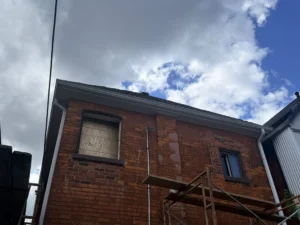
The 4 reasons renovation costs spiral out of control
These four causes account for the overwhelming majority of Hamilton renovation overruns. They don’t always arrive together — but when they do, a project can run 40–60% over the original quote. Here’s what each one actually looks like and what stops it.
1. Scope creep the problem that starts as a good idea
Scope creep is what happens when the project you agreed to quietly becomes a bigger project, one conversation at a time.
It rarely starts as dishonesty. It starts as a reasonable question on site. The kitchen is already open, so why not move the island? The basement is already framed, so why not add a bathroom rough-in while we’re here? Each individual change feels small. Together, they become a different project than the one you priced except without a different price attached.
According to Novesta, a Canadian renovation scope management firm, 67% of renovation projects experience scope creep with those overruns averaging 45% above the original budget. On a $65,000 project, that’s nearly $30,000 in unplanned costs from decisions that felt reasonable in the moment.
The problem isn’t the changes. It’s that they happen without a written, priced scope update. A verbal “yeah, we can do that” from a tradesperson on site is not a cost commitment. It’s an invitation for a dispute at invoice time.
What this costs in Hamilton: Individual undocumented change orders on a typical Hamilton basement renovation run $800–$3,500 each. Four undocumented changes can add $8,000–$12,000 to a project budgeted at $50,000–$65,000 a 15–20% overrun from scope creep alone, before permits or hidden conditions enter the picture.
What stops it: Every change to scope during construction must be documented in writing with a price before the work happens. Not after. Not “we’ll sort it at the end.” Ontario’s Consumer Protection Act requires this, it’s not a courtesy, it’s the law. A contractor who won’t slow down long enough to write a change order for a $2,000 addition is a contractor who won’t be easy to dispute when the invoice arrives.
2. Vague contracts, the legal exposure most homeowners don’t see coming
A renovation contract that says “complete kitchen renovation $45,000” is not a contract. It’s a number on a page.
A real scope of work specifies what’s included and what isn’t. It defines materials, finishes, brands, labor inclusions, what happens if something unexpected is found, and what the change order process looks like. Without that specificity, the contract is a blank cheque with a ceiling the contractor controls — and you have limited legal recourse when the final invoice doesn’t match your expectations.
Under Ontario’s Consumer Protection Act, if a written estimate is part of a renovation contract, the final price cannot exceed that estimate by more than 10% without the homeowner’s written agreement to a new scope and new price. The key phrase is “written estimate included in the contract.” If your contract has no written estimate — just a total number with no itemized scope — this protection is harder to enforce.
This is exactly why the contract structure matters before you sign, not after.
Fixed-price vs. cost-plus — the difference that decides who carries the risk:
| Contract type | Who carries cost risk | What it means for you |
|---|---|---|
| Fixed-price (lump sum) | Contractor absorbs underestimation | You pay the agreed amount. Errors are their problem. |
| Cost-plus | Homeowner pays actual costs + markup | Final bill reflects what the job actually cost — not what was quoted |
| Time-and-materials | Homeowner pays hourly + materials | No ceiling. Slow days cost you money too. |
Gateway Group operates on fixed-price contracts with a detailed written scope. If we’ve miscalculated something, that’s our problem not yours. The number you agreed to is the number on the final invoice.
What to ask before signing: Request a line-item scope that defines every material, every trade, and every phase. Ask explicitly: “Is this a fixed-price contract?” If a contractor won’t provide one, ask why the answer will tell you something.
3. Permit surprises what Hamilton’s building code actually requires
Permits are the most misunderstood part of a renovation budget and the most expensive to get wrong.
Many Hamilton homeowners assume permits are optional, or that a good contractor handles them invisibly in the background. Neither is true. In Hamilton, you are required to obtain a building permit before:
- Finishing a basement
- Converting or adding a secondary suite or ADU
- Removing a load-bearing wall or making structural changes
- Altering electrical or plumbing systems
- Building or significantly modifying a deck attached to the home
These aren’t suggestions. They’re legislated requirements under the Ontario Building Code, enforced by the City of Hamilton’s Building Division. Starting work without a required permit can result in a stop-work order, fines of up to $50,000 for individuals on a first offence under the Ontario Building Code Act (ontario.ca), and the part that actually stings a legal requirement to tear out completed work so it can be inspected properly. Unpermitted work also surfaces as a problem at sale: a home inspector will flag it, and a buyer’s lawyer will require resolution before closing.
What permits cost in Hamilton: Permit fees for a standard basement renovation typically run $300–$800. For a secondary suite or ADU conversion, costs are higher depending on engineering drawings required. The permit fee is rarely the budget problem what the permit process reveals is.
The harder problem: When a permit application triggers code requirements that weren’t in the original scope. In a pre-1960 Hamilton home, a basement renovation permit may require the city inspector to evaluate the entire floor’s electrical, HVAC, and fire separation systems not just the area being renovated. Code upgrades on systems you weren’t planning to touch become part of your project cost.
A contractor who handles permitting in-house, and builds permit timelines into the project schedule, accounts for this. A contractor who treats permits as an afterthought submits the application after work starts and calls you when the inspector flags something.
Timeline reality: The Ontario Building Code guarantees a permit decision within 10 business days once a submission is deemed complete. Reaching “complete” status can take additional weeks if drawings need revision or Conservation Authority / heritage clearance is required. A contractor whose schedule doesn’t account for this will be late and late projects have carrying costs.
4. Hidden conditions what older Hamilton homes don’t tell you until the walls come open
This one is genuinely unpredictable. But that doesn’t mean you can’t plan for it.
When a renovation contractor opens walls in a Hamilton home built before 1980, they’re working in a property that may contain:
- Knob-and-tube wiring that requires full replacement before new circuits can be added
- Asbestos-containing materials in insulation, drywall compound, or floor tiles requiring professional abatement
- Undersized electrical panels that can’t support a modern kitchen or basement suite
- Galvanized steel plumbing corroding internally, with reduced flow and elevated failure risk
- Structural lumber that doesn’t meet current code spans or load requirements
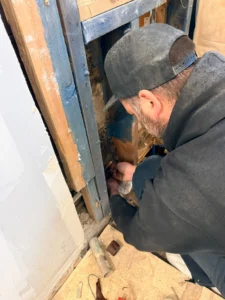
None of these are visible before demolition starts. But an experienced contractor working in Hamilton’s older housing stock one who has spent twelve years opening walls across Durand, Strathcona, Crown Point, and the North End knows they’re likely. They price for contingency. They communicate what they find before proceeding. They don’t add it to the invoice and call it a surprise.
The widely accepted rule of thumb for renovation contingency budgeting in Ontario is 10–20% of total project cost. On a $70,000 renovation, that means setting aside $7,000–$14,000 before work starts.
A contractor presenting a budget with no contingency allocation isn’t being competitive. They’re being incomplete and you’ll pay for that incompleteness when the walls come open.
What a proper pre-construction assessment looks like: Before quoting, an experienced contractor should walk the property and flag likely hidden conditions based on the home’s age, visible indicators (updated panel vs. original, replaced plumbing vs. galvanized at the basement ceiling, evidence of previous asbestos abatement), and the specific renovation scope. That assessment is what separates a quote that holds from one that becomes a negotiation after demolition.
What a fixed-price contract actually protects you from
Fixed-price contracts get misrepresented in contractor conversations constantly. Here’s what they do and don’t cover specifically.
What a fixed-price contract covers: The price on the contract is what you pay for the scope described in that contract. If the contractor underestimated labor, that’s their problem. If materials cost more than budgeted, that’s their problem. You are not the backstop for their estimating errors.
What a fixed-price contract doesn’t automatically cover:
- Genuinely undiscoverable hidden conditions (knob-and-tube behind a wall that gave no indicator of its presence)
- Changes you request after signing
- Permit-triggered code upgrades not in the original drawings
- Scope changes you initiate verbally on site
This distinction matters because some contractors offer “fixed-price” contracts with exclusion lists four pages long. The document says fixed price. The fine print says everything that actually causes overruns is excluded.
What to look for in a real fixed-price renovation contract:
- A line-item scope defining every material, trade, and finish not a summary description
- A written change order clause: no scope changes proceed without written agreement and a revised price
- A concealed conditions clause: what happens procedurally when something unexpected is found (work stops, condition documented, homeowner signs off before proceeding)
- A milestone-based timeline, not just a start date and an estimated completion
- Written warranty terms: what’s covered, for how long, and the process for raising a concern
What daily updates actually change about a renovation
The second most common complaint about renovation contractors, after budget overruns, is communication. Homeowners describe going weeks without a clear update, finding out about problems after the fact, and watching decisions get made on site without their input.
This matters beyond the frustration. Information gaps create financial exposure.
When a homeowner finds out a condition was discovered two weeks after it happened, they’re learning about it after the contractor already decided how to handle it. That decision may have cost implications they didn’t consent to. It may have created code compliance issues they now own. Daily communication doesn’t eliminate surprises but it eliminates decisions made without you.
What daily updates actually provide:
- Early scope drift detection. When you see daily photos and a brief summary, you notice the moment something changes from what you agreed to. That’s a conversation you can have before it costs money to fix.
- A documented record. If there’s ever a dispute about when a condition was found, what was decided, or what the homeowner approved, the communication thread is the evidence. That record protects both parties but it especially protects the homeowner.
- Right-time input. Renovation decisions need to be made quickly on site. Daily updates mean you see decisions coming and can respond before the moment passes rather than ratifying something already done.
- A signal about project management. A contractor who can’t send a daily photo and one paragraph about what happened either isn’t organized enough to do it, or isn’t confident enough in the day’s progress to share it.
Gateway Group clients receive daily WhatsApp updates throughout the project what happened that day, what’s planned for tomorrow, and any conditions or decisions that need input. When you know what’s happening every day, nothing on the final invoice should surprise you.

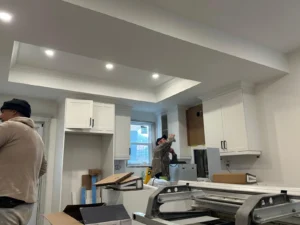
How Gateway Group approaches a renovation project
Gateway Group is a Tarion-registered design-build company. Not a general renovation contractor. That distinction has three specific meanings for the homeowner:
Tarion registration means regulated accountability. Tarion is Ontario’s builder warranty program registration requires meeting competency standards, carrying defined insurance, and providing statutory warranty coverage. Not every contractor qualifies. When something goes wrong mid-project or after completion, a Tarion-registered builder has a regulated dispute pathway that a non-registered contractor doesn’t. That’s not a badge. It’s a legal protection on your investment.
Design-build means one company from drawings to completion. There’s no handoff between a designer who drew the plan and a contractor seeing it for the first time on site. What gets designed is what gets built. That continuity reduces the gap between what was planned and what the inspection requires.
12 years in Hamilton means local knowledge that matters. An inspector’s typical concerns on a pre-1960 Durand home are different from those on a 1985 Ancaster split-level. The permit pathway for a basement suite on a Crown Point lot is different from one in Stoney Creek. We’ve been navigating this city’s permit process, zoning specifics, and inspection standards since 2012. That experience is priced into our assessments — which means fewer surprises after work starts.
Our process on a renovation project:
- Site visit and scope development : we walk the property, document what’s visible, flag what’s likely behind the walls based on the home’s age and indicators, and build a scope that reflects what we actually know. Not what we hope.
- Fixed-price proposal : you receive a detailed scope with a fixed price. Miscalculations are our problem.
- Permit application : we handle drawings, submissions, and coordination with Hamilton’s Building Division. You don’t manage this.
- Construction with daily updates : Cory leads on-site work. You hear from us before you think to ask.
- Final walkthrough and close-out : we walk the completed project with you. Any deficiencies are addressed before we consider the project done.
Gateway’s verified credentials:
- Tarion registration (Ontario’s builder warranty program)
- 4.9 stars from homeowners across Hamilton
- West End Home Builders’ Association — Award of Distinction 2025
- Operating in Hamilton since 2012
If your renovation involves converting a basement to a legal secondary suite, adding a duplex or triplex unit, or building a garden suite, those projects carry additional complexity ADU-specific permit pathways, zoning requirements, and Hamilton’s Housing Sustainability Investment Roadmap grant program, which can cover up to 70% of eligible construction costs to a maximum of $40,000 per unit. We’ve covered those in detail separately.
Before you sign anything a checklist
If you take nothing else from this post, take this list. Before signing a renovation contract in Hamilton with any contractor — confirm each of the following in writing:
- A line-item written scope, not a summary description
- A fixed price tied to that specific scope
- A written change order process no verbal changes proceed without a price
- A permit plan who applies, what’s required, what the timeline is
- A concealed conditions clause, what happens procedurally when something unexpected is found
- A communication plan, how often, what format, who contacts who
- A contingency acknowledgement, what the contractor’s recommendation is, and why
- Warranty terms in writing, what’s covered, for how long, and the process for deficiency resolution
- Proof of Tarion registration or equivalent regulated credential
Every one of these should have a clear, documented answer before you hand over a deposit. If it doesn’t, the risk you’re taking on is real and it’s preventable.
FAQ: renovation cost overruns in Hamilton
Why do most renovations go over budget in Ontario?
Most renovation budget overruns in Ontario stem from four causes: a vague scope of work signed without a fixed-price contract, permit requirements that weren’t anticipated before work started, hidden structural or mechanical conditions found after walls open, and scope creep from undocumented changes during construction. Under Ontario’s Consumer Protection Act, all changes to a renovation contract must be agreed to in writing with a revised price before additional work proceeds. The most reliable protection combines a detailed fixed-price contract with a 10–20% contingency reserve.
Do I need a building permit for a renovation in Hamilton?
Most significant renovation work in Hamilton requires a building permit under the Ontario Building Code. Projects that require permits include finishing a basement, adding or converting a secondary suite or ADU, removing load-bearing walls, altering plumbing or electrical systems, and constructing or significantly modifying a deck attached to the home. Cosmetic work — painting, flooring replacement, cabinet installation generally does not require a permit. If you’re unsure, the City of Hamilton’s Building Division can confirm. Starting work without a required permit can result in fines of up to $50,000 and a legal requirement to demolish and re-inspect completed work.
What does a fixed-price renovation contract actually cover?
A fixed-price contract covers the scope of work described in the contract, at the price stated. If the contractor miscalculates labor or materials, they absorb the difference. What it doesn’t automatically cover: changes you request after signing (these require written change orders with revised pricing), genuinely hidden conditions that couldn’t reasonably have been found before demolition, and permit-triggered code upgrades not in the original scope. Always review what the contract excludes not just what it includes. A contractor who won’t show you the exclusion list is not offering you a real fixed-price contract.
How much should I budget for contingency on a Hamilton renovation?
The standard industry recommendation for Ontario renovation contingency is 10–20% of total project cost. On a $60,000 basement renovation, that means $6,000–$12,000 set aside before work starts. In Hamilton, where older housing stock means more frequent hidden condition discoveries knob-and-tube wiring, galvanized plumbing, asbestos-containing materials budgeting at the higher end of that range is prudent for any pre-1970 property. A contractor who presents a budget with no contingency isn’t being competitive. They’re being incomplete.
Is a Tarion-registered builder different from a regular renovation contractor in Hamilton?
Yes, in a legally significant way. Tarion registration requires builders to meet specific competency standards, carry defined insurance, and provide statutory warranty coverage on their work. Not all renovation contractors qualify. The difference matters most when something goes wrong mid-project or after completion: a Tarion-registered builder has a regulated dispute resolution process that a non-registered contractor doesn’t provide. Gateway Group is Tarion-registered. That protection comes with every project.
What should I ask a renovation contractor before signing?
Ask whether the contract is fixed-price or cost-plus. Ask to see the line-item scope, not just the total. Ask who handles permit applications and what happens to the contract price if the permit triggers code upgrades. Ask what the concealed conditions clause says — specifically, what the process is when something unexpected is found. Ask how they communicate during the project and what a typical Tuesday update looks like. Ask whether past clients experienced significant cost changes from the original quote. The answers tell you more than any portfolio photo.
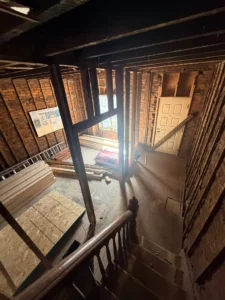
Ready to talk about your project?
Gateway Group has been building in Hamilton since 2012. Every project starts with a proper site assessment not a number from a 20-minute walkthrough.
If you’re planning a basement renovation, a legal secondary suite, a duplex conversion, or a full-home project, the right starting point is understanding what your property actually contains before you agree to a price. That assessment is what makes a quote hold.
No cost. No pressure. Just a clear picture of what your project actually involves and what it will cost.
Legal Basement Suites & ADU Builders in Hamilton