Hamilton’s $40,000 ADU Grant Explained: What It Actually Covers, Who Qualifies, and How to Get It
9 April 2026
Can Your Hamilton Property Support a Garden Suite? Here’s How to Find Out in 10 Minutes
5 May 2026
Hamilton Police issued a warning about renovation fraud again this spring. It happens every year, contractors show up, collect deposits, and disappear. Or they finish the job, but do it without permits, without accountability, and without any recourse if something goes wrong six months later.
If you’re planning a basement suite conversion, a duplex, a garden suite, or any multi-unit residential project in Hamilton, you’ll be making a $90,000 to $200,000+ decision. Picking the right builder matters more than finding the lowest quote.
This isn’t a general warning post. This is a practical guide written by a Tarion-registered Hamilton builder with a 12 year track record on exactly how to verify who you’re hiring, what questions to ask before you sign anything, and what the red flags look like in the real world.
If you’ve been comparing quotes and something doesn’t feel right, this is the page to read before you commit to anyone.
What This Guide Covers
- What Tarion registration actually means and how to verify it
- The difference between a registered builder, a licensed contractor, and an unlicensed renovator
- 5 questions to ask before hiring any builder in Hamilton
- The red flags that show up in quotes and contracts before work starts
- Why comparing quotes without matching scope is a mistake
- How Gateway Group works and what you should hold any builder to
First: Why Hamilton Homeowners Are Getting This Wrong
The problem isn’t that Hamilton homeowners are careless. It’s that the contractor market in Ontario is confusing by design.
Anyone can call themselves a contractor. Anyone can print a business card, build a basic website, and post on Facebook Marketplace. There’s no single license requirement that covers all renovation work in Ontario which means the bar to entry is low, and the variation in accountability is enormous.
Add to this: homeowners shopping for basement conversions or multi-unit builds are often doing it for the first time. They don’t have a reference point for what a real scope of work looks like. They don’t know what a legitimate pre-construction agreement includes. They’re comparing quotes based on price, because price is the only thing that’s easy to compare.
That’s where the risk lives. Not in picking someone dishonest on purpose but in not knowing what legitimacy looks like, so you can’t spot its absence.
Here’s what legitimacy looks like in Hamilton in 2026.
What Tarion Registration Actually Means
Tarion is Ontario’s new home warranty program. It administers the Ontario New Home Warranties Plan Act which means it sets the standard for who can legally build and sell new homes in Ontario, and it provides warranty coverage to buyers.
But here’s what most homeowners don’t know: Tarion registration isn’t just about new custom home builds. It applies to multi-unit residential conversions basement suites being added to existing structures, duplex and triplex conversions, garden suites, and fourplex infill developments.
If a builder is doing this kind of work and is not Tarion-registered, they are operating outside the framework that gives you legal recourse when something goes wrong.
What Tarion registration requires from a builder:
- Registration with Tarion verifiable through the Ontario Builder Directory
- Adherence to the Ontario Building Code on every project
- Financial accountability builders can lose registration for financial mismanagement
- Accountability for warranty coverage on covered work
- Oversight by the Home Construction Regulatory Authority (HCRA)
How to verify a builder’s Tarion registration:
Go to the Ontario Builder Directory at ontario.ca/builder registry. Search the company name or registration number. If they’re registered, it appears. If they’re not, they’re not in the system and no story about ‘we’re in the process of registering’ changes that. Work only begins with builders in the directory.
GATEWAY: Gateway Group’s Tarion registration number is available on request and is verifiable in the Ontario Builder Directory. We’ve been registered since we started. That’s not a credential we added later it’s been the foundation of how we operate.
The Three Tiers of Builders in Ontario and What Each One Means For You
Not all contractors are created equal. When you’re hiring for a basement suite, duplex conversion, or garden suite in Hamilton, you’re likely to encounter people in one of three categories. Knowing the difference changes how you evaluate their quote.
1. Tarion-Registered Builder
This is the highest accountability tier for residential construction in Ontario. To hold this status, a builder must maintain registration with Tarion and HCRA, meet financial standards, and be accountable for warranty coverage. Their projects are subject to inspection. Their practices are on record.
For multi-unit residential conversions which are new dwelling units being added to existing structures \this is the standard you should require. Not because it’s required by law in every specific renovation scenario, but because it’s the standard that gives you legal recourse and real accountability.
2. Licensed General Contractor
A licensed general contractor holds a business license and typically has trade-specific licenses for work like electrical and plumbing. They’re accountable in the sense that they can be reported to the relevant college or licensing body if something goes wrong.
For finished basement renovations without a dwelling unit creation, a good licensed contractor may be sufficient. But for anything creating a new legal unit a basement apartment, a garden suite, a duplex conversion you’re in territory where Tarion registration matters.
3. Unlicensed Renovator
This is the widest category and the most dangerous one. There is no registration body, no financial accountability structure, and no meaningful recourse if the work is wrong, the budget changes without notice, or the contractor disappears. Permits may or may not be pulled. Work may or may not be done to code. Your only option when something goes wrong is small claims court or worse.
This is who Hamilton Police is warning you about every spring. And they look exactly like the first two categories when they show up for a quote.
KEY QUESTION: Ask every builder directly: ‘Are you Tarion-registered? Can I verify your registration number in the Ontario Builder Directory?’ The answer and how quickly they give it, tells you a great deal.
5 Questions to Ask Any Builder Before You Sign Anything in Hamilton
These aren’t trick questions. They’re the questions a legitimate builder should answer immediately, with specifics. If the answers are vague, delayed, or defensive, that’s the answer.
Question 1: Are you Tarion-registered, and can I see your registration number?
Already covered above but ask it first. A registered builder gives you the number without hesitation. An unregistered builder gives you an explanation. There’s no acceptable explanation.
Question 2: Who pulls the permits you, or the homeowner?
Permits for basement suite conversions, duplex work, and garden suites in Hamilton are not optional. They’re required by the Ontario Building Code, and skipping them puts you at serious risk.
A legitimate builder pulls their own permits. This matters because it means the builder is accountable for the work to the city not just to you. When a builder pulls a permit, the city inspects the work at multiple stages. Problems get caught before they’re buried in drywall.
When a homeowner is told to pull their own permit or when permits aren’t discussed at all it usually means the builder doesn’t want city inspectors looking at their work.
We’ve seen projects in Hamilton that had to be torn out because permits weren’t pulled. The city ordered it. The homeowner paid twice. We’ve never had that happen on a Gateway project because our permits are pulled before our subs touch anything.
Question 3: What’s included in your pre-construction agreement?
A real pre-construction process separates serious builders from everyone else.
Before any shovels go in the ground, a legitimate builder should offer a consulting agreement that covers: a detailed scope of work, a real cost estimate (not a range so wide it’s meaningless), a project timeline with milestones, and a clear description of what’s included and what isn’t.
If a builder wants to move straight from ‘I can do it’ to ‘here’s your start date,’ they’re skipping the step where they prove they’ve actually thought through your specific property. That’s where cost overruns start. That’s where the ‘I didn’t quote for that’ conversations happen.
The pre-construction consulting agreement is where surprises get killed before they become expensive. If a builder doesn’t have one, ask why.
GATEWAY: Every Gateway project starts with a pre-construction consulting agreement. You see the detailed scope and the real numbers before you commit to construction.
Question 4: Who are your subcontractors, and how long have they worked with you?
Most builders on projects of any scale use subcontractors for specialty trades electrical, plumbing, HVAC. This is normal and not a red flag by itself.
What matters is whether those subcontractors are vetted, consistent, and known to the builder. A builder who’s worked with the same electrical sub for eight years has a working relationship that produces consistent results. A builder who finds whoever is available on a given week has a different accountability structure for that work.
Ask: ‘Who does your electrical? How long have you worked together? Can I see a previous project?’ The answers to those questions reveal a lot about how the job will actually be managed.
Question 5: Can you provide a reference from a similar project in Hamilton?
This one gets skipped more often than any other. It shouldn’t.
A builder who’s done multiple basement suite conversions in Hamilton has a track record you can verify. A builder who ‘does all kinds of renovation work’ and happens to be available for your project is a different risk profile.
Ask for a reference from a project of similar scope a basement apartment conversion, a duplex, a garden suite. Ask the reference specifically about budget, timeline, and communication during the build. Those three things are where almost every renovation relationship breaks down.
GATEWAY: Charles offers references on significant projects. That’s not a marketing line it’s a standing offer. If you’re comparing quotes and want to speak to someone who’s been through a full duplex or basement suite conversion with us, ask. We’ll connect you.
Red Flags That Show Up Before Work Starts
You don’t have to wait for something to go wrong to spot a problem. Most of the warning signs show up before a single tool is unpacked — in the quote, in the conversation, in the contract.
No permits offered, or permits actively discouraged
‘We can skip the permit to save you time and money’ is one of the most expensive sentences a homeowner can hear. If you skip the permit on a basement suite conversion in Hamilton and the city finds out, you may be ordered to restore the space to its pre-conversion state. That means tearing out finished work at your cost.
Any builder who suggests skipping permits on a multi-unit conversion is either unaware of the requirements (bad) or aware and still suggesting it (worse).
Vague scope ‘we’ll figure it out as we go’
Cost overruns almost always start with a vague scope. ‘We’ll figure out the HVAC routing when we’re in the walls’ sounds reasonable until the routing adds three weeks and $12,000. A builder who can’t give you a detailed written scope before work starts can’t give you a reliable number either.
No written agreement before work starts
Verbal agreements are not enforceable in any meaningful way in construction. If the only thing you have is a conversation about what it’s going to cost and how long it’s going to take, you have nothing. Get the scope, the price, the timeline, and the payment schedule in writing before anyone starts.
Requesting large cash deposits with no documentation
A reasonable deposit structure for a large renovation project might be 10–15% upfront, with milestone-based payments tied to specific stages of work. A contractor asking for 30–50% cash upfront before any work is done with no documentation and no written agreement — is a signal to stop.
Hamilton Police’s 2026 spring advisory noted exactly this pattern: contracts signed, large deposits collected, and then nothing. Every year. The deposits are gone before the homeowner realizes there’s a problem.
No Tarion number, and reasons why they don’t need one
Some builders will argue that Tarion registration isn’t required for renovation work and in some specific scenarios, that’s technically true. But if a builder is creating a new dwelling unit in your home — adding a basement suite, splitting a house into a legal duplex, building a garden suite at the back they are operating in territory where Tarion oversight matters. If they’re dismissing it entirely, that dismissal is worth understanding.
Why Comparing Quotes Without Matching Scope Is a Mistake
Three quotes for a basement suite conversion: $82,000, $97,000, $126,000.
The instinct is to look at that spread and ask what the $126K builder is charging for. The better question is: what is the $82K builder not including?
Renovation quotes for complex residential work are not standardized documents. There’s no rule that says two quotes for a ‘basement suite’ have to cover the same scope. One builder might include separate electrical panel, egress window installation, fire separation, HVAC ducting, and separate entrance. Another might quote only the visible interior work and assume the homeowner figures out the rest.
When you compare those quotes as if they’re comparable, you’re comparing apples to something that isn’t a fruit.
What a complete scope for a basement suite conversion in Hamilton should include:
- Design and permit application (pulled by the builder)
- Fire separation between units required by Ontario Building Code
- Egress window if bedrooms are included
- Separate electrical panel and meter (if separate utility billing is required)
- HVAC either separate system or properly zoned from existing
- Separate entrance exterior work included
- Plumbing rough in and connection to main stack
- Insulation to code including sound separation between floors
- All inspections through to final permit close
If a quote doesn’t address all of these explicitly, ask. Not to catch the builder out but because your final cost will reflect whether these items are included or not. A $90K quote that excludes the egress window, separate entrance, and electrical panel can become a $115K project. A $115K quote that includes all of it is a better deal.
GATEWAY: Every Gateway quote for a basement suite conversion covers the full scope permits, fire separation, HVAC, egress, electrical, separate entrance, and final inspection. When you compare our number to another number, ask the other builder to show you their line items.
The Hamilton Specific Context: What Makes This Market Different
Hamilton’s housing policy landscape has changed significantly in the last three years. Missing middle zoning amendments have opened up properties that previously couldn’t legally add units. Garden suites and laneway housing have specific new pathways. Fourplexes are now permitted as-of-right in many residential zones.
This is creating demand for builders who understand not just how to build, but what Hamilton’s zoning actually allows — and how to navigate the permit process for multi-unit residential work specifically.
Most general renovators don’t have this knowledge. They can finish a basement. They don’t know what fire separation between a basement unit and the upper floor requires under the Ontario Building Code, or what Hamilton’s zoning bylaw says about minimum suite size, or how to handle a separate entrance that requires disturbing the municipal sidewalk line.
This is where builder selection matters beyond just credentials. It’s about whether the person you hire has actually done this kind of work in Hamilton, with Hamilton’s specific permit office, and can show you the permits they’ve pulled.
Charles Wah has been on Hamilton’s Missing Middle Subcommittee. That’s not a credential we list because it sounds impressive. It’s context Gateway builds in a policy environment that Charles has helped shape. That combination of field experience and policy familiarity is genuinely rare in this market.
How Gateway Group Works What You Should Hold Any Hamilton Builder To
We’re not going to pretend this section isn’t also a positioning section. It is. But we’re going to tell you exactly how we work so you have a real standard to compare against not marketing language, but actual process.
Step 1: Property Read
Send us your address and what you’re considering. We’ll do a zoning and feasibility read, what’s actually possible on your property, given lot size, existing structure, and current Hamilton zoning. This happens within 24–48 hours. No charge. No sales call.
Step 2: Discovery Call with Cory
If the property read looks promising, Cory our construction lead who’s on every job does a discovery call with you. This is a real conversation about what’s buildable, what the constraints are, and what the process looks like. Not a sales presentation. A construction conversation.
Step 3: Pre-Construction Consulting Agreement
If there’s a fit, we enter a consulting agreement before any construction work is priced. This covers a detailed site assessment, a full scope of work, a real cost estimate with line items, and a project timeline. You see the numbers before you commit to construction. No surprises built in at the back end.
Step 4: Permits
We pull our own permits. Every time. We submit to the City of Hamilton, we follow up, and we manage the process. You don’t deal with the permit office. That’s part of what you’re hiring us for.
Step 5: Construction with Tarion Oversight
Build phase runs with Tarion registration covering the project, city inspections at every required stage, and a WhatsApp group for daily updates. Cory is the point of contact on-site. You don’t have to wonder what happened today you’ll know.
Step 6: Final Inspection and Permit Close
The project isn’t done when the last tile goes in. It’s done when the final permit is closed by the city. That’s what makes it a legal unit. We stay through to that point.
TRACK RECORD: Gateway Group has been building in Hamilton since 2012. 4.9 stars. Tarion-registered throughout. WEHBA Award of Distinction 2025. References available on significant projects.
Frequently Asked Questions
How do I know if a builder is Tarion-registered in Ontario?
Go to the Ontario Builder Directory at ontario.ca/builder registry and search the company name or their registration number. If they don’t appear, they’re not registered. You can also ask them directly for their registration number a legitimate builder provides it immediately.
Is Tarion registration required for basement renovations in Hamilton?
Not for all basement renovations. But for projects that create a new dwelling unit a legal basement apartment, a duplex conversion, a garden suite Tarion registration is the standard that matters. If a contractor is building a new unit in your home and is not registered, you lose the warranty protections and recourse that registration provides.
What questions should I ask a contractor before hiring them in Hamilton?
Ask: Are you Tarion-registered? Who pulls the permits? Do you have a pre-construction consulting agreement? Who are your subcontractors and how long have you worked with them? Can you provide a reference from a similar project? The answers to these five questions will tell you more than the quote amount.
What are the red flags for renovation fraud in Hamilton?
Hamilton Police identified the following warning signs in their 2026 spring advisory: contractors approaching you unsolicited, pressure to sign quickly, requests for large upfront cash deposits with no documentation, discouraging permits as unnecessary, and no written contract before work starts. Any of these should stop a conversation until you’ve had time to verify the contractor’s credentials.
How do I compare renovation quotes fairly in Hamilton?
Ask every builder to give you an itemized scope of wor not just a total price. Confirm which items are included and which are not. For a basement suite conversion, make sure each quote addresses permits, fire separation, egress windows, separate entrance, electrical panel, HVAC, and final inspection. Once you have matching scopes, the price comparison is meaningful. Without matching scopes, it isn’t.
What’s the difference between a legal and illegal duplex in Hamilton?
A legal duplex has been converted with proper permits, inspected at all required stages, and meets the Ontario Building Code for fire separation, egress, HVAC, and electrical. An illegal duplex has been converted without permits — which means it may not meet code, may have to be restored to single-unit status if discovered, and cannot be legally rented as a second unit. The difference is significant for both resale value and legal liability.
How long does a basement suite conversion take in Hamilton?
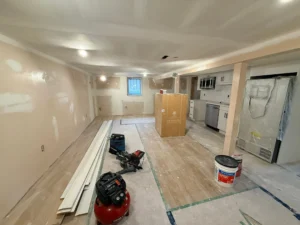
A properly permitted basement suite conversion in Hamilton typically takes 10–16 weeks from permit approval to final inspection. Permit timelines in Hamilton have been running 6–12 weeks for residential projects. We submit, follow up, and manage the permit process — the construction clock starts when permits are approved, not before.
Does Gateway Group handle both the renovation and the permits?
Yes. We pull all permits on Gateway projects. We submit to the City of Hamilton, follow up through the review process, and coordinate all required inspections. The homeowner doesn’t deal with the permit office that’s part of what we manage end-to-end.
The Right Question Isn’t ‘Who’s Cheapest’
Hamilton homeowners planning a basement suite, duplex conversion, or garden suite are making one of the largest investments they’ll make in their property. The decision about who builds it shapes everything, the quality of the finished unit, the legal standing of the conversion, the rent you can charge, and the liability you carry if something is wrong.
The lowest quote and the best outcome are almost never the same project.
That’s not a critique of any specific competitor. It’s just the reality of how renovation scopes get built, what gets included, what gets left out, and who’s accountable when the walls are open and something unexpected happens.
We’ve been building in Hamilton since 2012. We’re Tarion-registered. We pull our own permits. We use the same subcontractors on every job because the results are consistent. We send daily updates because no-contact construction is how trust breaks down.
If you’re comparing quotes right now, we’d invite you to compare scopes first and then we’re happy to talk.
DM us your address. We’ll tell you honestly what’s possible, what it would actually cost, and whether it makes sense to go further.