Hamilton Legal Basement Apartment & Multi-Unit Conversion, What Gets Approved?
7 February 2026
What Hamilton Homeowners Are Actually Making From Legal Suite Conversions in 2025
3 March 2026
If you already own property in Hamilton and feel like it should be producing more income or value, you may be right. Many homes in Hamilton have untapped potential from legal basement apartments to duplex conversions or smaller layout refinements. This guide explains the real problems that cause properties to underperform, what typically fixes them, and how to evaluate your own property before spending money.
Owning property in Hamilton today puts you in a strong position.
But ownership alone doesn’t mean the property is optimized.
Many homes across Hamilton from older brick houses on the Mountain to century homes downtown are structurally capable of more than they’re currently doing.
The issue isn’t always expansion, it’s misalignment.
Here are five signs your property may be underperforming and what that actually means in practical terms.
1. The Layout Doesn’t Match Today’s Rental Reality

The problem:
Older homes were designed for one household. Long hallways, oversized bedrooms, awkward circulation space these layouts don’t always translate well to modern rental demand.
What this causes:
- Lower rent per square foot
- Poor unit separation potential
- Missed opportunity for secondary suite configuration
We see this constantly: a property “feels big,” but it doesn’t function efficiently.
The solution isn’t always adding units. Sometimes it’s restructuring space:
- Moving stairs
- Separating entrances properly
- Reconfiguring kitchens and bathrooms
- Creating clean suite separation without structural overreach
If your layout could reasonably support two self-contained units but isn’t configured that way, that’s a performance gap.
2. The Basement Exists But It’s Not Compliant
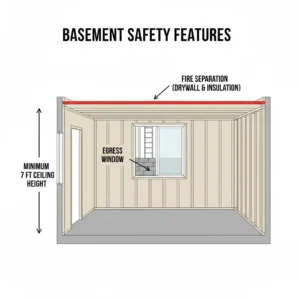
The problem:
Many Hamilton homes have basements that are:
- partially finished
- rented informally
- renovated years ago without permits
Homeowners frequently ask:
Can I legalize my basement apartment in Hamilton?
Here’s the real answer:
It depends on whether the basement can meet:
- minimum ceiling height
- proper egress requirements
- fire separation standards
- ventilation requirements
- safe exit access
The practical solution:
Before investing in finishing, test feasibility:
- Measure ceiling heights precisely
- Evaluate window size and location
- Assess structural implications of adding fire separation
If those align cleanly, a legal basement apartment can dramatically improve performance.
If they don’t, forcing it can cost more than it returns.
3. Your Lot May Be Stronger Than the Building
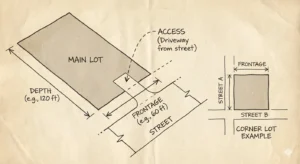
The problem:
Owners focus on the house and ignore the land.
In Hamilton, lot geometry often determines what’s realistically possible.
Things that quietly matter:
- frontage width
- lot depth
- corner positioning
- side-yard clearance
- driveway alignment
These factors influence whether you can:
- create proper duplex separation
- accommodate parking requirements
- add a garden suite
- pursue small multi-unit infill
Many properties underperform because the owner never assessed what the lot itself supports.
The land may be capable of more than the current structure is showing.
4. The Structure Can Support Density But No One Tested It
The problem:
Owners assume adding units means rebuilding.
In reality, many older Hamilton homes were built with strong structural systems that can support additional configuration.
But structural capacity must be evaluated properly:
- Can new fire-rated separations be installed without major structural compromise?
- Can exits be created safely?
- Can services (plumbing, electrical, HVAC) be separated logically?
When these align, duplex and triplex conversions can make sense. When they don’t, you end up chasing redesign after redesign.
The mistake isn’t trying density. The mistake is assuming density without structural review.
5. Parking Is Assumed Impossible Without Being Tested
Parking often becomes the emotional barrier.
Owners say:
“There’s no room.”
But in practice:
- Some configurations allow tandem parking.
- Some approvals do not require additional parking depending on context.
- Some lots can be reconfigured.
Where projects fail is when parking geometry isn’t analyzed early. Access and turning radius matter more than driveway width alone. For small multi-unit and fourplex projects, parking and access are often the deciding factor.
Not the number of bedrooms. Not the rent projections. Access.
The Real Issue: Owners Delay Because They’re Unsure
Most underperformance isn’t because owners don’t want to improve. It’s because they’re unsure whether improvement is realistic.
Common hesitation patterns:
- “I don’t know if zoning allows it.”
- “What if the permit gets denied?”
- “What if the basement doesn’t meet code?”
- “What if I spend on drawings and it doesn’t work?”
That uncertainty causes delay and delay leaves equity underutilized.
What Smart Owners Do Instead

Before committing to design or construction, experienced investors and informed homeowners test three things:
- Permission alignment: Does the property realistically support the intended use under current regulations?
- Building compliance feasibility: Can life-safety and code standards be met without excessive intervention?
- Timeline realism: If approvals take longer than expected, does the plan still make financial sense?
This is not about optimism. It’s about informed progression.
FAQs
How do I know if my Hamilton property is underperforming?
If you have unused space, inefficient layout, or lot characteristics that support additional density but haven’t evaluated them, your property may not be optimized.
Is legalizing a basement apartment worth it in Hamilton?
It can be, if the basement meets ceiling height, egress, fire separation, and ventilation requirements. Testing compliance early prevents costly redesign later.
Can I convert my Hamilton house into a duplex or triplex?
Possibly. The outcome depends on zoning permissions, structural feasibility, exit requirements, and site constraints like parking and access.
Do I need permits for these changes?
Yes, in most cases. Structural changes and additional dwelling units require permits and inspections to ensure compliance.
Already Own in Hamilton? Here’s the Next Step.
If you suspect your property may be underperforming but you’re not sure whether the solution is a legal basement apartment, duplex conversion, layout refinement, or something else, clarity is the first move.
Send us the address.
Contact Us
We’ll review:
- layout efficiency
- basement feasibility
- lot positioning
- structural adaptability
- parking and access flexibility
Not every property needs expansion, some need alignment.