Why Renovations Spiral Out of Control in Hamilton And How to Stop It Before You Start
18 May 2026
Legal Duplex Conversion in Hamilton: What’s Actually Required
4 June 2026
If you’ve spent any time comparing quotes for a basement conversion, duplex, or legal suite in Hamilton, you’ve probably heard both words builder and contractor used as if they mean the same thing. They don’t. And confusing them could cost you thousands of dollars, a failed permit, or a project that has no warranty protection the moment something goes wrong. This guide breaks down the legal and practical difference between a builder and a contractor in Ontario. It also covers what Tarion registration actually means for your property, how to read and compare quotes honestly, and the specific questions you should be asking before anyone breaks ground on your home.
1. Builder vs. Contractor vs. Renovator: What Ontario Law Actually Says
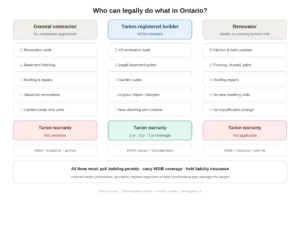
| In Ontario, a ‘builder’ is a person or company that constructs a new home or undertakes a conversion that qualifies as a new dwelling under the Ontario New Home Warranties Plan Act. A ‘general contractor’ manages the coordination and execution of renovation or construction work but does not necessarily carry Tarion registration. A ‘renovator’ performs work on an existing home without changing its fundamental classification. These are not interchangeable terms and which one applies to your project determines whether you have statutory warranty protection. |
Let’s be direct about something most companies won’t tell you upfront: the words ‘builder’ and ‘contractor’ are used loosely in advertising and even in conversation. But in Ontario, they carry specific legal weight.
What is a General Contractor in Ontario?
A general contractor is a professional hired to manage and execute a construction or renovation project. They coordinate subcontractors plumbers, electricians, framers, HVAC technicians and are responsible for budget, schedule, and quality control. In Ontario, there is no universal provincial licensing requirement to call yourself a general contractor for residential renovation work. What is required: proof of WSIB coverage, liability insurance, and compliance with local building codes and municipal permits.
This means a general contractor can legally do renovation work on your home including finishing a basement, adding a bathroom, or installing a kitchen without holding any formal registration with a regulatory body, as long as they pull the correct permits and meet code.
What is a Builder in Ontario?
A builder in Ontario is a person or company that constructs a new home or creates a new residential unit through conversion. Under the Ontario New Home Warranties Plan Act (ONHWPA), any person who builds a new home or converts an existing structure so that it qualifies as a new home must be licensed through the Home Construction Regulatory Authority (HCRA) and registered with Tarion. This matters enormously for certain types of projects. Adding a legal basement suite, building a garden suite, converting a house to a duplex or fourplex depending on the scope and how the City classifies the work, you may be dealing with a new dwelling unit, not just a renovation. If that is the case, only a Tarion-registered builder can legally undertake that work and provide you with new home warranty protection.
What is a Renovator?
A renovator works on existing homes without changing their classification as a dwelling. Finishing a basement for personal use, updating a kitchen, repairing a roof these fall under renovation. No Tarion registration required. What is required: building permits where applicable, WSIB, insurance, and licensed trades for electrical and plumbing work.
The Terminology Problem and Why It Matters in Hamilton
Hamilton’s housing market has created an explosion of multi-unit conversion projects, driven partly by the City’s Missing Middle policies and provincial zoning reforms under Bill 23. As a result, many homeowners are attempting projects that blur the line between renovation and new construction. They hire a ‘contractor’ assuming the project is just a renovation and end up with work that legally required a licensed builder, no Tarion coverage, failed inspections, or worse: units the City will not approve for occupancy.
| If the work creates a new dwelling unit where one didn’t exist before basement suite, garden suite, additional unit in a conversion — ask specifically whether Tarion registration is required for your project and your municipality. |
| Term | What it means in Ontario |
| General Contractor | Manages and executes renovation or construction work. Coordinates trades. No mandatory provincial registration for residential renos — but must carry WSIB, insurance, and pull permits. |
| Builder (HCRA-licensed) | Constructs or converts to create new residential units. Must be licensed by HCRA and registered with Tarion. Required for new home warranty coverage. |
| Renovator | Works on existing homes without changing their residential classification. Permits still required for structural, plumbing, and electrical work. |
| Constructor (legal term) | Under Ontario’s Occupational Health and Safety Act, the party with overall control of a construction project. Can be the general contractor or the owner themselves if managing separate trades. |
| Design-Build Firm | Handles both design and construction under one contract. Can hold builder or contractor status depending on the scope of work and registration. |
2. What Tarion Registration Actually Does for You
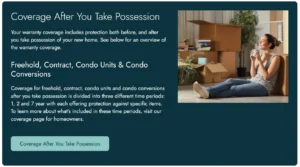
What the Tarion Warranty Covers
| Coverage Period | What It Protects |
| One Year (Workmanship & Materials) | Defects in work and materials things that are not built to code or don’t function as intended. |
| Two Years (Major Systems) | Water penetration through the building envelope, heating, plumbing, and electrical systems. |
| Seven Years (Structural) | Major structural defects failure of load-bearing elements or anything that poses a risk to the safety or habitability of the home. |
| Pre-possession | Deposit protection up to $100,000 and compensation for delayed closing or possession. |
Why Tarion Registration Matters for Hamilton Multi-Unit Conversions
Hamilton has seen a surge in basement suite conversions, duplex and triplex splits, and garden suite construction all driven by rental demand and the City’s push for gentle density. Here is the question most homeowners don’t ask early enough: does my project create a new dwelling unit?
If the answer is yes, and if you want proper warranty coverage, you need a Tarion-registered builder. A general contractor without that registration can still do excellent work but they cannot provide you with the statutory warranty that comes with a newly created residential unit. If something goes wrong structurally or with major systems after they leave, your legal options are limited to whatever is in your private contract.
| A licensed contractor can legally do renovation work in Ontario, but only a Tarion-registered builder can provide the new home warranty coverage required for certain conversion types including some basement suites, garden suites, and multi-unit conversions. |
How to Verify Tarion Registration
The Ontario Builder Directory is publicly searchable at obd.hcraontario.ca managed by the Home Construction Regulatory Authority (HCRA); Tarion links to it directly from their site. Before signing any contract for a project that creates a new dwelling unit, search your builder’s name. You can see their registration status, any past warranty claims or chargeable conciliations, and their track record of completed projects.
One thing worth knowing before you start: as of April 1, 2026, freehold homebuyers in Ontario are required to register their new home purchase with Tarion within 45 days of signing and it takes just a few minutes through their online portal. This lets Tarion confirm early that your builder has met their obligations and gets you set up with the right warranty information from day one. It’s also a key protection for you as a buyer: every completed sale gets verified, which helps keep unlicensed builders out of the market before they can do damage.
3. How Much Does It Cost to Hire a General Contractor in Ontario?
One of the most common questions Hamilton homeowners search before making any calls: how much does a general contractor actually cost? The answer has several layers.
How Contractors Charge: Fee Structures Explained
| Fee Structure | How It Works |
| Percentage of Project Cost (10–20%) | Most common for larger projects. GC marks up total project cost. On a $100,000 basement conversion, that is $10,000–$20,000 in GC fees alone. |
| Fixed-Price Contract | Contractor quotes a locked total. Lower risk for the homeowner — no surprises from scope creep. Requires detailed upfront planning. |
| Cost-Plus | Homeowner pays actual costs plus a percentage markup. Offers transparency but removes cost certainty. Can run over budget. |
| Hourly Rate | Used for small scopes or undefined work. Rates in Hamilton typically range $65–$120/hour for a site supervisor. |
Gateway Group operates exclusively on fixed-price contracts. Every quote is locked before a shovel touches your property. If the job runs long or materials cost more than expected, that is our problem, not yours.
Typical Project Costs in Hamilton, 2025 Market Data
These ranges reflect current Southern Ontario pricing. Hamilton typically sits slightly below Toronto pricing due to lower labor Small lot fourplex (new build, per unit) demand, but above rural Ontario rates.
| Project Type | Typical Hamilton Cost Range (2025) |
| Basic basement finishing (personal use) | $40,000 – $65,000 |
| Legal basement suite (1 bedroom) | $85,000 – $110,000 |
| Cash-flow rental suite (separate entrance, kitchen, full bath) | $105,000 – $120,000 |
| Duplex conversion (existing home) | $120,000 – $200,000 |
| Garden suite (new build) | $200,000 – $450,000 |
| Small lot fourplex (new build, per unit) | $185,000 – $375,000 |
Why the Cheapest Quote is Often the Most Expensive Outcome
This is the most important financial reality of hiring a contractor in Ontario, and the one most homeowners learn the hard way. A permit costs between $2,000 and $4,500 for a basement renovation in Hamilton. Some contractors skip it to lower their quote. When you go to sell the property, the unpermitted work gets flagged in the sale process. You either need to pull after-the-fact permits (expensive and not always possible) or disclose the violation to buyers, which tanks your sale price.
A legal basement suite that is not built to code for fire separation can fail a fire inspection. The City of Hamilton can order the unit closed until it meets code. That means no rental income, plus remediation costs, on top of the original construction cost. Unlicensed electrical and plumbing work is not covered by your home insurance. If there is a fire or flood caused by substandard work done without a permit, your insurer has grounds to deny the claim.
| The right question is not: ‘Which contractor is cheapest?’ The right question is: ‘Which company gives me a fixed price that covers everything I need to do this properly and never have to redo it?’ |
4. How to Evaluate Competing Quotes, what’s Actually in the Number
Getting three quotes is standard advice. But three quotes are only useful if you know what each one includes and excludes. Most homeowners compare the final number. That is the wrong place to start.
The Quote Comparison Checklist
When reviewing any quote for a Hamilton multi-unit conversion or basement project, verify each of the following:
- Permits included or excluded? If a contractor quotes ‘plus permits,’ ask exactly what permits are required and what they will cost.
- Design and drawings included? Many lower quotes exclude architectural drawings, which are required for permit applications. These typically cost $2,000–$6,000 separately.
- Structural engineering included? If the scope involves removing walls, changing openings, or adding a separate entrance, engineering drawings may be required. Add $1,500–$4,000 if not included.
- Licensed trades or subcontractors? Electrical and plumbing in Ontario must be performed by licensed trades. Ask: ‘Are your electricians and plumbers licensed?’ Get a yes with specifics, not just yes.
- WSIB and insurance documentation? Ask for a current WSIB clearance certificate and proof of liability insurance. If a worker is injured on your property and the contractor isn’t covered, you may be liable.
- Project timeline and communication protocol? Ask how you’ll be updated. Vague answers here predict vague management on site.
- What happens if costs go over? A fixed-price contract protects you. A cost-plus or time-and-materials contract puts all cost risk on you.
- Warranty terms after completion? Beyond Tarion (if applicable), what does the contractor warranty on their own work? One year is standard minimum. Get it in writing.
A Real Scenario: Two Quotes, $30,000 Apart
A Hamilton homeowner gets two quotes for a legal basement suite. Quote A: $78,000 all-in. Quote B: $108,000.
They almost go with Quote A. Then they ask the right questions.
Quote A excludes: architectural drawings ($4,500), permits ($3,200), licensed electrician ($6,800), egress window installation ($3,500), separate electrical panel ($4,200). That brings Quote A to $100,200— and that is if nothing changes mid-project. Quote A is also from a contractor who cannot tell you whether this project requires Tarion registration.
Quote B is fixed-price. It includes everything. There are no add-ons.
The $30,000 gap was mostly in what each quote chose to leave out.
5. The 10 Questions to Ask Before Hiring Any Builder or Contractor in Ontario
| Before hiring a builder or contractor in Ontario, ask: (1) Are you Tarion-registered and HCRA-licensed if this project creates a new unit? (2) Is your price fixed? (3) Do you pull all permits? (4) Can you provide current WSIB and liability insurance certificates? (5) Are your trades licensed? (6) Who is on site daily? (7) How do I receive project updates? (8) What is your timeline and what causes delays? (9) Can I see references from similar Hamilton projects? (10) What does your warranty cover after completion? |
Are you Tarion-registered and HCRA-licensed?
For projects that create a new dwelling unit basement suite, garden suite, duplex this is non-negotiable. Ask for their HCRA license number and verify it in the Ontario Builder Directory before any conversation continues. A contractor who deflects this question is telling you something important.
Is your quote a fixed price?
Fixed-price means the number you see is the number you pay. Period. If a contractor hesitates on this or uses words like ‘estimated’ or ‘approximately,’ push back. Get clarity on what triggers a change order and how changes are priced.
Do you pull all required permits and is that included in your price?
In Ontario, the building permit is technically the homeowner’s legal responsibility — but a reputable contractor manages this entirely on your behalf. If a contractor suggests skipping permits to save time or money, walk away. Unpermitted work creates problems at sale, with your insurer, and with the City.
Can you provide WSIB clearance and liability insurance certificates today?
Not ‘we’ll send them later.’ Today. If a company is operating legally, these documents are ready. Request liability insurance with at least $2 million coverage for residential projects. Request a WSIB clearance certificate dated within 30 days.
Are your electricians and plumbers licensed in Ontario?
In Ontario, electrical contracting requires a license. Ask for the license number and the name of the electrical contracting business. This protects you from liability if uninspected electrical work causes a fire or loss event down the road.
Who is physically on my site every day?
Some contractors quote the job but never appear on-site. Work is delegated to loosely supervised subcontractors. You want to know who is responsible for site supervision, quality control, and daily progress. The answer should be a named individual with a title not ‘my guys.’
How will I receive project updates?
Communication is where renovation projects succeed or fall apart. Ask for their specific protocol: daily WhatsApp updates, weekly site walks, email reports? If the answer is vague — ‘we’ll keep you in the loop’ — expect to spend weeks chasing someone for information about your own property.
What is a realistic timeline and what causes delays?
Ask for a project timeline with named milestones: permit approval, demo, framing, rough-in, drywall, finishes, final inspection. Ask what their policy is when there are delays caused by weather, permit processing, or supplier issues. A contractor who gives you a vague ‘eight to twelve weeks’ without milestones has not planned the project yet.
Can you provide references from similar Hamilton projects in the past two years?
References from basement suites, duplexes, or multi-unit conversions in Hamilton specifically. When you speak with them, ask three things: Was the final price what was quoted? Was the timeline what was communicated? Would you hire them again without hesitation?
What does your warranty cover after the project is complete?
Beyond statutory Tarion coverage (where applicable), what does the contractor warranty on their own workmanship? One year is standard minimum. Get the scope of that warranty in writing before signing anything.
6. What a Tarion-Registered Builder Looks Like in Practice Gateway Group
Gateway Group has been building in Hamilton since 2012. In that time, the company has completed basement suites, legal second units, duplexes, triplexes, and, most recently, Hamilton’s first small lot fourplex development under the Kiwanis Homes Initiative three sites across the city currently in active excavation.
Gateway is Tarion-registered. That registration is not something the company lists as a marketing badge. It is the structural guarantee behind every project that creates a new dwelling unit. Every homeowner who builds a legal suite through Gateway gets statutory warranty protection — one year, two year, seven year regardless of what else happens.
A few things that distinguish what a credentialed design-build firm delivers in practice:
- Fixed-price contracts. Every project. No change orders for budget overruns caused by poor planning on our end.
- Daily WhatsApp client updates. You know what is happening on your property every single day. That is not a feature. It is the promise.
- Same crew from roofing to conversion work. No loose subcontractor chains. Our team handles the full scope structural, mechanical, finishing under one roof and one standard.
- All permits managed in-house. Drawings, applications, municipal coordination, final inspections. If it involves a permit in Hamilton, we manage it.
- Charles Wah sits on Hamilton’s Missing Middle and Infill Development Subcommittee. This is not a bio line. It means Gateway is in the room where Hamilton’s zoning and infill policy gets shaped. Our clients benefit from that knowledge directly.
Our 4.9 Google rating and WEHBA Award of Distinction 2025 are third-party signals. But the most accurate proof is the one you do yourself: ask to speak with a homeowner whose basement suite we completed in the past 18 months. We’ll connect you.
7. Hamilton-Specific Context: What the City’s Housing Incentive Program Means for Your Decision
There is a hard deadline: occupancy must occur by August 4, 2027. Permits must have been issued after October 9, 2025.
This program has a significant implication for the builder vs. contractor question. To access municipal incentives, your project must meet the City’s standards for legal occupancy. Unpermitted work and work done by companies without the required credentials will not qualify. The City issues incentive payments at permit issuance and occupancy — both of which require inspections.
If you want to access up to $40,000 in City of Hamilton incentives, your project needs to be done by a company that does everything properly. There is no shortcut to that outcome.
| Hamilton Incentive Program — Key Details | |
| Incentive level | 70% of eligible costs, up to $40,000 per unit |
| First payment | Up to $8,000 at permit issuance |
| Remainder | Paid at occupancy |
| Permit requirement | Must be issued after October 9, 2025 |
| Occupancy deadline | August 4, 2027 |
| Boundary requirement | Property must be within HHCIPA boundary |
| Zoning constraints (garden suites) | 4.0m setback, 75 sqm max gross floor area, two-bedroom maximum |
Frequently Asked Questions
The following questions reflect what Hamilton homeowners are actively searching in 2025–2026. This section is formatted for FAQ schema markup in WordPress.
Is a builder the same as a contractor in Ontario?
No. In Ontario, a builder is specifically someone who constructs or converts property to create a new residential dwelling — they must be HCRA-licensed and Tarion-registered under the Ontario New Home Warranties Plan Act. A general contractor manages construction and renovation projects but is not required to hold Tarion registration. For projects that create new dwelling units — basement suites, garden suites, multi-unit conversions — a Tarion-registered builder is required to provide statutory warranty protection.
How much does it cost to hire a general contractor in Ontario?
General contractors in Ontario typically charge between 10% and 20% of the total project cost as their management fee. For a legal basement suite in Hamilton, total project costs range from $85,000 to $120,000 based on 2025 market data. The cheapest quote is rarely the best value — ask specifically what permits, drawings, and licensed trades are included in the price before comparing numbers.
What questions should I ask before hiring a builder in Ontario?
The ten most important questions: (1) Are you Tarion-registered and HCRA-licensed? (2) Is your price fixed? (3) Do you pull all permits? (4) Can you provide WSIB and liability insurance certificates? (5) Are your trades licensed? (6) Who is on site daily? (7) How will I receive project updates? (8) What is the project timeline with milestones? (9) Can I speak with recent Hamilton references? (10) What does your post-completion warranty cover?
Does a basement conversion in Hamilton require a Tarion-registered builder?
It depends on how the City of Hamilton classifies the work. A basic basement finishing for personal use is typically a renovation and does not require Tarion registration. A legal basement suite — adding a separate unit with kitchen, bathroom, and separate entrance — may qualify as a new dwelling unit under the ONHWPA, potentially requiring a Tarion-registered builder. Always clarify this with your contractor before signing, and verify independently with your permit application.
What does the City of Hamilton’s housing incentive program pay for?
The City of Hamilton’s ADU and Multi-Plex Housing Incentive Program (February 2026) provides 70% of eligible costs up to $40,000 per unit. The first payment of up to $8,000 is released at permit issuance; the remainder is paid at occupancy. Permits must be issued after October 9, 2025 and occupancy must occur by August 4, 2027. The property must fall within the HHCIPA boundary.
How do I verify that a builder is Tarion-registered in Ontario?
Search the Ontario Builder Directory at tarion.com. Enter the builder’s name or registration number. You can view their current registration status, licence history, past warranty claims, and chargeable conciliations. For any project that creates a new dwelling unit, this verification step should happen before any contract is signed.
What does a fixed-price contract mean in construction?
A fixed-price contract means the quoted amount is the total amount you will pay — period. Changes to the scope of work may result in documented change orders with agreed pricing, but the contractor absorbs cost overruns caused by their own planning, labor, or material estimates. Fixed-price contracts reduce financial risk significantly for homeowners and are the industry standard for credentialed design-build firms in Ontario.
Not Sure Which Type of Project You Have?
| Send Us a Message — We’ll Tell You Honestly What Applies.
Not sure if your project is a renovation or a new unit? Not sure if you need Tarion coverage? Not sure how to read the quote you just received? We’ve been building in Hamilton since 2012. Tarion-registered. 4.9 stars. WEHBA Award of Distinction 2025. DM us your address we’ll give you the honest answer in 24 hours. |